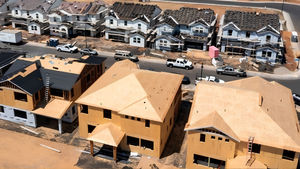
43% of Homebuilders Are Cutting Prices. Could Chicago New-Construction Buyers Find Better Deals?

CHICAGO— Higher mortgage rates are putting pressure on homebuilders, and buyers are beginning to see the response.
New data released October 19 by the National Association of Home Builders found that 43% of U.S. builders cut home prices in October, the highest share recorded during the 2020-2026 period. The average reduction remained 6%, while another 65% of builders reported using sales incentives to attract buyers. National Association of Home Builders
For someone shopping for new construction around Chicagoland, that sounds like an obvious opportunity.
But there is an important catch:
Those are national figures. They do not mean 43% of Chicago-area builders are cutting prices or that every new subdivision suddenly has negotiable pricing.
What the numbers do suggest is that buyers should be asking more questions than they might have a year or two ago, particularly about closing-cost credits, mortgage-rate buydowns, quick-move-in homes and incentives tied to a builder's preferred lender.
Why Builders Are Offering More Incentives
The October report reflects a difficult affordability environment for new-home buyers.
The NAHB/Wells Fargo Housing Market Index fell to 29, its lowest reading since June 2012. Buyer traffic also dropped sharply as mortgage rates, construction costs and other expenses continued to pressure the market.
Mortgage rates help explain why.
Freddie Mac reported that the national average 30-year fixed mortgage rate was 7.40% as of October 15, compared with 6.95% only four weeks earlier.
Builders cannot control mortgage rates, but they have several ways to make a home more attractive without simply slashing the advertised price.

That might mean contributing toward closing costs, paying discount points to lower a buyer's mortgage rate, offering a temporary rate buydown, including upgrades that normally cost extra or reducing the price of a completed inventory home.
Some Chicagoland communities are already advertising versions of those incentives. For example, current Pulte listings in Bolingbrook and Batavia have advertised promotional financing on select homes, including temporary buydowns or below-market adjustable-rate offers. The programs have qualification requirements and can be limited to particular homes, contracts and affiliated financing.
That does not establish a Chicago-wide discount trend. It simply shows why buyers should investigate the complete offer instead of judging a new home by list price alone.
A Builder Credit Is Not the Same as a Price Cut
This is one of the most important distinctions for buyers.
A builder might offer a $15,000 incentive, but that does not necessarily mean the house costs $15,000 less.
The money could instead be restricted to closing costs, upgrades or financing through the builder's preferred lender.
A mortgage-rate buydown works differently again.

With discount points, money is paid upfront to obtain a lower interest rate. The Consumer Financial Protection Bureau notes that one point equals 1% of the loan amount, although the amount by which that point reduces the interest rate depends on the lender and market.
A temporary buydown may reduce the buyer's payment only during the first year or several years. After that introductory period, the payment increases to the loan's full note rate.
That is very different from a builder permanently paying enough discount points to reduce the rate for the entire mortgage term.
This is why an advertisement showing a particularly low first-year rate should never be compared directly with a normal 30-year fixed quote without reading the financing terms.
How to Compare New Construction With a Resale Home
A buyer may find a newly built home at $550,000 and an established resale nearby at $525,000.
The resale initially looks cheaper.
But suppose the builder is offering closing-cost assistance, a financing incentive and appliances or upgrades that the resale buyer would otherwise need to purchase.
Now the comparison becomes less obvious.
On the other hand, the resale seller might be willing to negotiate the price, provide a closing-cost credit or already have landscaping, window treatments, a finished basement and other improvements that cost thousands to add to a new home.
The right comparison is therefore not:
New home list price versus resale list price.
It is total cost versus total cost.
When comparing the two, buyers should look at:
the final negotiated purchase price
interest rate and whether it is temporary, fixed or adjustable
discount points and who is paying them
closing-cost credits
builder upgrades and what is actually included in the base price
lot premiums
HOA fees
property taxes
appliances, landscaping, blinds and other post-closing costs
inspection findings and near-term repairs on a resale
expected completion date and potential construction delays
A resale home may still be the stronger value. A new home may win instead.
The incentive itself should not make that decision.
Ask What Happens When the Promotional Rate Ends
Rate incentives deserve especially close attention right now because the gap between an advertised builder rate and the broader mortgage market can look dramatic.
The CFPB recommends comparing mortgage options with the same amount of points or credits because different lenders may structure their offers differently. A loan advertised with discount points may look cheaper than another loan even though the buyer is paying more upfront to obtain that rate.
For any builder financing offer, ask:
What is the note rate? Is this a permanent or temporary buydown? What will the payment become later?
What is the APR? How many points are being paid? Do I have to use the builder's lender to receive the incentive?
Then request a comparable quote from another lender.
You may discover that the builder financing is genuinely valuable.
Or you may decide a larger price reduction or closing-cost credit would be more useful than temporarily lowering the payment.
The Best Deal May Be Something Other Than a Lower Price
For buyers, the headline opportunity is not necessarily "builders are desperate."
It is that there may be more ways to negotiate the complete transaction.
A buyer who expects to stay in the home for many years may value a permanent rate reduction.
Someone trying to preserve cash after closing might prefer a credit toward closing expenses.
Another buyer may care more about eliminating a lot premium, adding a finished basement or negotiating upgrades that would otherwise come out of pocket.
And sometimes the best offer is simply a lower purchase price.
The key is putting a dollar value on each option instead of accepting the incentive with the biggest-looking number.
Shopping New Construction Around Chicagoland? Compare the Incentive, Not Just the Home
National builder concessions are increasing, but the opportunity in Chicago depends on the specific community, builder, inventory and financing offer.
The Cory Tanzer Group at Option Premier helps buyers compare new construction with resale homes, builder incentives, recent comparable sales, HOA costs, property taxes and neighborhood alternatives across Chicago and the surrounding suburbs.
With mortgage rates still around 7%, asking the right questions about financing can matter almost as much as negotiating the purchase price.
A builder offering a deal can be valuable.
The better question is whether it is the right deal for you.
Stay Connected
Ranked among the top 1% of real estate teams in the Chicagoland market, The Cory Tanzer Group at Option Premier is recognized for proven sales performance, neighborhood expertise, and consistent results across Chicago and the surrounding suburbs.
In the 2026 RealTrends Verified rankings, based on 2025 sales data, the team completed 181 transaction sides representing $79.28 million in sales volume. The Cory Tanzer Group ranked No. 13 in Illinois by transaction sides, No. 20 in Illinois by sales volume, No. 270 nationally by transaction sides, and No. 439 nationally by sales volume.
The team also earned The CARLY, the highest honor for Platinum Sales Dollars and Platinum Units Sold, at the Chicago Association of REALTORS® Sales Awards.
Led by Cory Tanzer, the team helps buyers, sellers, investors, landlords, and renters navigate real estate across Downtown Chicago, the North Shore, and the Western Suburbs, with local expertise in University Village, University Commons, South Loop, West Loop, Little Italy, Pilsen, and surrounding Chicagoland communities.
Connect with The Cory Tanzer Group at Option Premier for trusted local market insight, personalized guidance, and a proven strategy for your next Chicago real estate move.