Chicago’s Bungalow Belt: What Buyers Should Know Before Buying One

Chicago’s bungalow belt is one of the city’s most important residential housing stories.
Across Chicago, there are more than 80,000 bungalows, representing roughly one-third of the city’s single-family homes. Most were built between 1910 and the early 1940s, and many follow a familiar design: brick construction, one-and-a-half stories, a low-pitched roof, wide eaves, a raised front porch, and a full basement.
On a map, these homes form a wide arc around the city, generally running 4 to 7 miles from downtown across the Northwest Side, Southwest Side, and South Side. That arc is known as the Chicago Bungalow Belt.
For buyers, bungalows can offer something increasingly hard to find in the city: detached-home living, private outdoor space, established blocks, transit access, and architectural character at a price point that may still be more accessible than many newer single-family homes.
What Is a Chicago Bungalow?
A classic Chicago bungalow usually sits on a narrow city lot, often around 25 feet wide by 125 feet deep.
The home is typically one-and-a-half stories above a full basement, with a low hipped roof, wide eaves, and a front porch raised from the sidewalk. The street-facing side often includes a bank of large windows, with a dormer above to bring light into the upper floor.
Almost all Chicago bungalows are brick, which is part of why so many have lasted for more than a century.
The bungalow style did not begin in Chicago. The word traces back to a low house form associated with British India, later adapted in California as a more informal Arts and Crafts-style home. Chicago’s version became its own distinct housing type because it had to respond to narrow lots, cold winters, dense urban blocks, and the need for affordable homeownership at scale.
Where the Bungalow Belt Runs
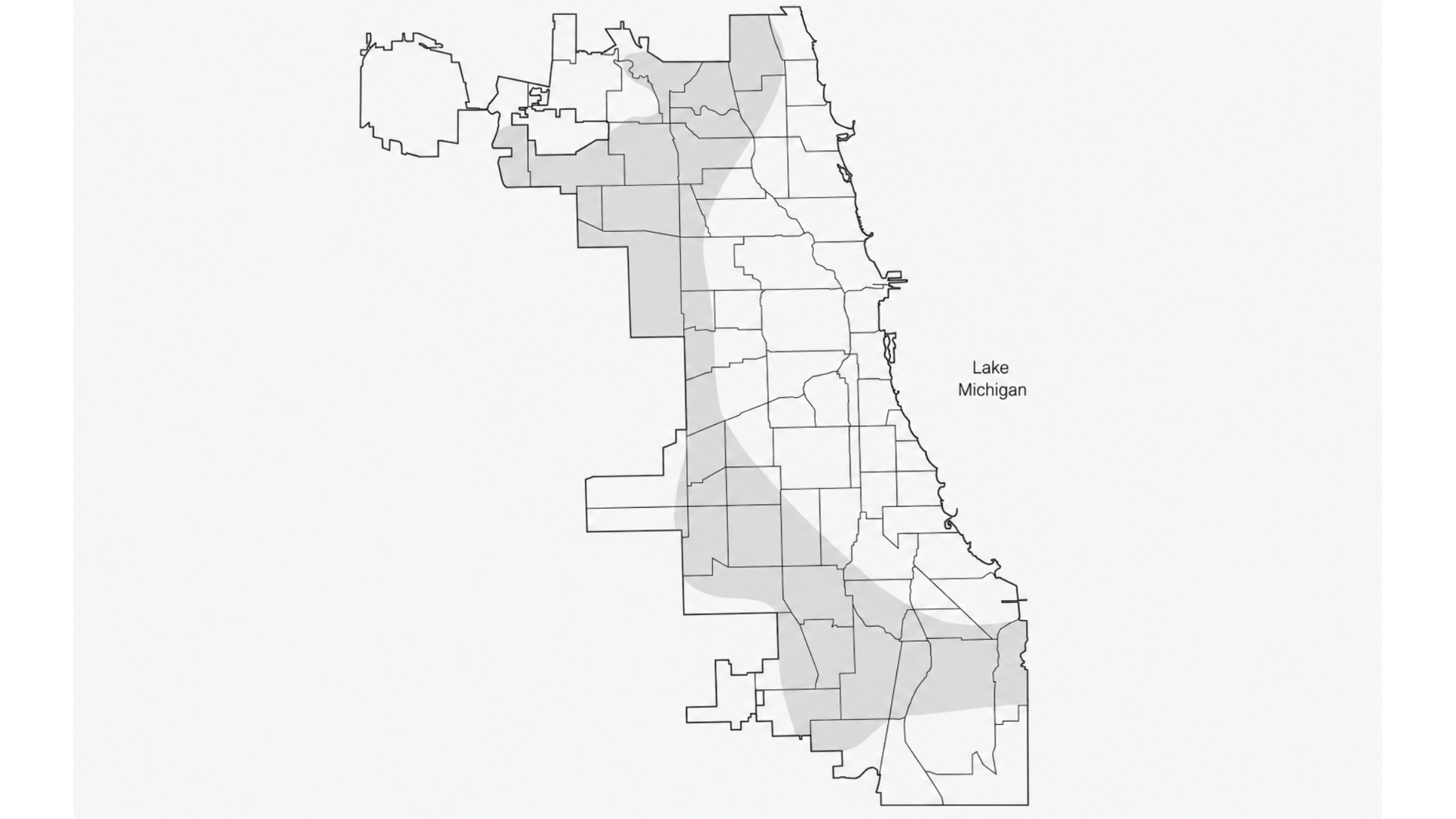
The bungalow belt crosses many Chicago neighborhoods, each with its own price points, architecture, transit access, and buyer profile.
On the Northwest Side, the belt includes areas such as Portage Park, Jefferson Park, Norwood Park, Edgebrook, Belmont Cragin, and Avondale. In some of these neighborhoods, bungalows make up a major share of the residential housing stock.
On the Southwest Side, the belt becomes especially dense, running through neighborhoods such as Bridgeport, Brighton Park, Marquette Park, West Lawn, Chicago Lawn, Gage Park, McKinley Park, and Archer Heights.
On the South Side, the belt continues through Chatham, Auburn Gresham, Greater Grand Crossing, South Shore, Calumet Heights, Beverly, and Morgan Park.
Beverly stands out because of its architectural variety. The neighborhood is known for well-preserved bungalow blocks, but also includes larger Tudor-style homes, giving it a more varied residential character than many surrounding areas.
Because the belt is so large, no two bungalow neighborhoods should be treated the same. Some areas have seen more renovation activity and buyer competition. Others remain more stable and working-class, with homes that may need updates but offer strong long-term ownership potential.
How the Bungalow Belt Was Built
The bungalow belt grew during a major period of Chicago expansion.
Between 1910 and 1930, Chicago added more than one million people. Many second-generation immigrant families were moving up economically and looking for homes of their own. Developers responded by buying open land near the edges of the city, dividing it into narrow lots, and building bungalows in large numbers.
At the time, bungalows were a practical path to homeownership. They were durable, efficient, and affordable compared with larger homes. Depending on size and finishes, many were priced between roughly $2,500 and $10,000 when first built.
By 1930, a large share of residential structures in the Chicago area were newly built, and the bungalow had become the dominant modestly priced house type for many working- and middle-class buyers.
That history also includes exclusion. For decades, many African American families were blocked from buying in bungalow belt neighborhoods through racially restrictive covenants, discriminatory lending, and housing policies that reinforced segregation.
The Supreme Court’s 1948 Shelley v. Kraemer decision made racially restrictive covenants legally unenforceable, but lending discrimination and other barriers continued long after that ruling. As Black families began moving into some bungalow belt neighborhoods, white flight reshaped parts of the South and West Sides. Later, Latino migration transformed many Southwest and Northwest Side communities.
Today, the bungalow belt reflects that layered history. Some neighborhoods are majority Latino. Others are majority Black. Others are mixed, and some have changed significantly through renovation, reinvestment, and rising buyer demand.
Preservation and the Chicago Bungalow Association
Chicago’s bungalow preservation efforts are also important for buyers to understand.
The city launched the Chicago Bungalow Initiative in 2001, which eventually became the Chicago Bungalow Association. The organization provides educational resources, design guidance, energy-efficiency programs, and support for owners of bungalows and other vintage homes.
Many bungalows across the city have been certified as Historic Chicago Bungalows, and multiple Bungalow Historic Districts have been established throughout the belt.
Certification can be valuable because it may help owners qualify for certain incentives, especially when improvements preserve the historic character of the home. That usually means protecting the original massing, rooflines, window patterns, and exterior appearance while allowing interior updates, mechanical improvements, and energy-efficiency work that does not compromise the home’s character.
For buyers, this can be a benefit, but it also requires planning. If a home is in a historic district or certified as a historic bungalow, exterior changes may require additional review. Before closing, buyers should understand what can be changed, what needs approval, and what incentives may be available.
What Buyers Should Watch Before Purchasing
Chicago bungalows can be excellent homes, but buyers should be careful and thorough.
The first thing to review is the basement. Some bungalow basements are unfinished storage areas. Others have been converted into family rooms, in-law arrangements, or additional living space. Buyers should confirm what was permitted, what is legal, and whether the work was done properly.
The half-story is also important. In some bungalows, the upper level is comfortable and functional. In others, ceiling height, roofline, insulation, and dormer placement can limit how useful the space really is. Photos do not always tell the full story, so buyers should walk the space carefully.
Buyers should also evaluate the lot, especially because many bungalows sit on standard 25-by-125-foot city lots. Yard size depends on how much of the lot the house occupies, where the garage is located, and how the outdoor space is configured.
Other important items include:
Roof condition
Brick and masonry
Windows
Electrical system
Plumbing
Heating and cooling
Insulation
Garage condition
Drainage
Basement moisture
Permits for past renovations
Historic district rules
Property taxes
Transit and neighborhood amenities
A bungalow may look simple from the outside, but a careful inspection and review of past improvements are essential.
Why Buyers Still Love Chicago Bungalows
The lasting appeal of Chicago bungalows comes from their combination of practicality and character.
They offer detached-home living on established city blocks. Many have private yards, garages, basements, solid brick construction, and original architectural details that are difficult to recreate today.
They also exist across a wide range of neighborhoods and price points. A buyer considering a bungalow in Portage Park may be looking at a different market than someone searching in Bridgeport, Beverly, Jefferson Park, or Chatham. That variety gives buyers options, but it also makes local guidance important.
The best bungalow purchase depends on the block, condition, renovation history, basement, lot, transit access, and long-term neighborhood fit.
Looking to Buy a Chicago Bungalow?
Whether you are comparing homes on the Northwest Side, Southwest Side, South Side, or nearby Chicagoland communities, the right strategy starts with understanding condition, layout, basement potential, historic rules, and neighborhood value. Connect with The Cory Tanzer Group at Option Premier for expert guidance on finding the right home and making a smart long-term move.
Stay Connected
Ranked among the top 1% of real estate teams in the Chicagoland market, The Cory Tanzer Group at Option Premier is recognized for proven sales performance, neighborhood expertise, and consistent results across Chicago and the surrounding suburbs.
In the 2026 RealTrends Verified rankings, based on 2025 sales data, the team completed 181 transaction sides representing $79.28 million in sales volume. The Cory Tanzer Group ranked No. 13 in Illinois by transaction sides, No. 20 in Illinois by sales volume, No. 270 nationally by transaction sides, and No. 439 nationally by sales volume.
The team also earned The CARLY, the highest honor for Platinum Sales Dollars and Platinum Units Sold, at the Chicago Association of REALTORS® Sales Awards.
Led by Cory Tanzer, the team helps buyers, sellers, investors, landlords, and renters navigate real estate across Downtown Chicago, the North Shore, and the Western Suburbs, with local expertise in University Village, University Commons, South Loop, West Loop, Little Italy, Pilsen, and surrounding Chicagoland communities.
Connect with The Cory Tanzer Group at Option Premier for trusted local market insight, personalized guidance, and a proven strategy for your next Chicago real estate move.
Looking for homes, condos, or investment opportunities in Chicago?