The Salt Shed Is Planning a Massive Expansion Along the Chicago River. Here’s What’s Coming
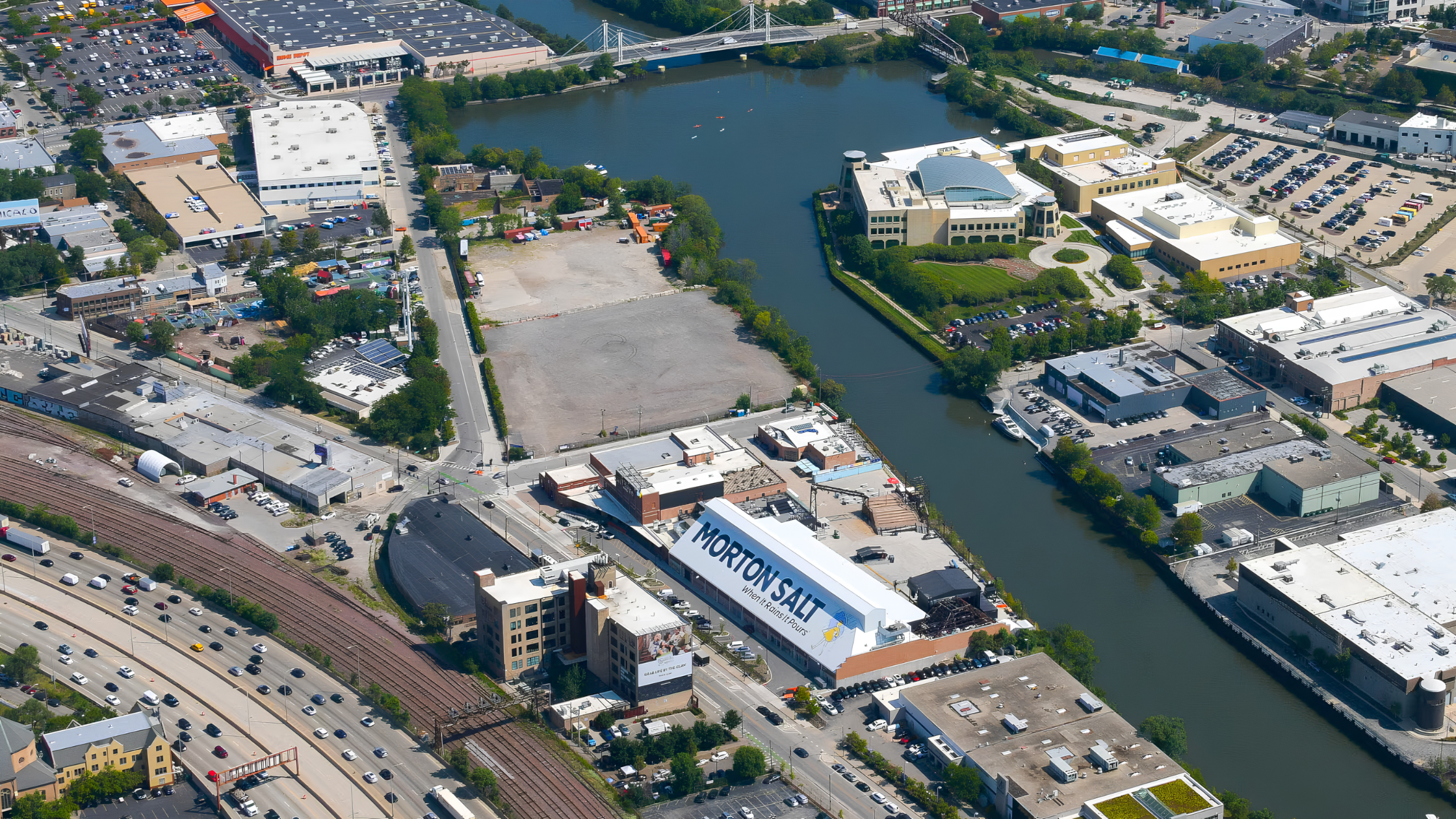
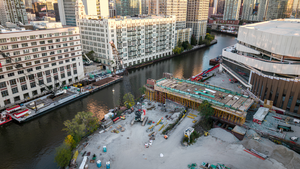
An aerial view of the Salt Shed and a five-acre site north of the property, which the music venue's owners are under contract to buy for a big expansion. (Curt Waltz/Aerialscapes.com)
WEST TOWN— The Salt Shed could become much more than one of Chicago’s best-known music venues.
New plans reveal a major expansion across from the existing complex along the North Branch of the Chicago River, with a new outdoor amphitheater, a large connecting plaza, a publicly accessible riverwalk, boat dock and additional event infrastructure.
The proposal covers the property at 1401-1459 N. Magnolia Avenue, where a zoning reclassification was introduced to City Council on October 14 as Application No. 23181. The zoning request remains in committee, which means the expansion is proposed, not approved.
The entertainment venue may grab the headlines. But the larger story is what is happening around it.
A stretch of riverfront once dominated by industrial operations is increasingly being reconsidered as a place for music, restaurants, recreation, public open space and new residential development.
What’s Proposed Across From The Salt Shed?
The latest plans, reported October 18, describe a development site of roughly 10 acres immediately north and across Blackhawk Street from the existing Salt Shed complex.
The proposal comes from the team behind the current venue, including Blue Star Properties, R2 Companies and hospitality group 16” On Center.
At the center would be a new amphitheater-style outdoor venue.
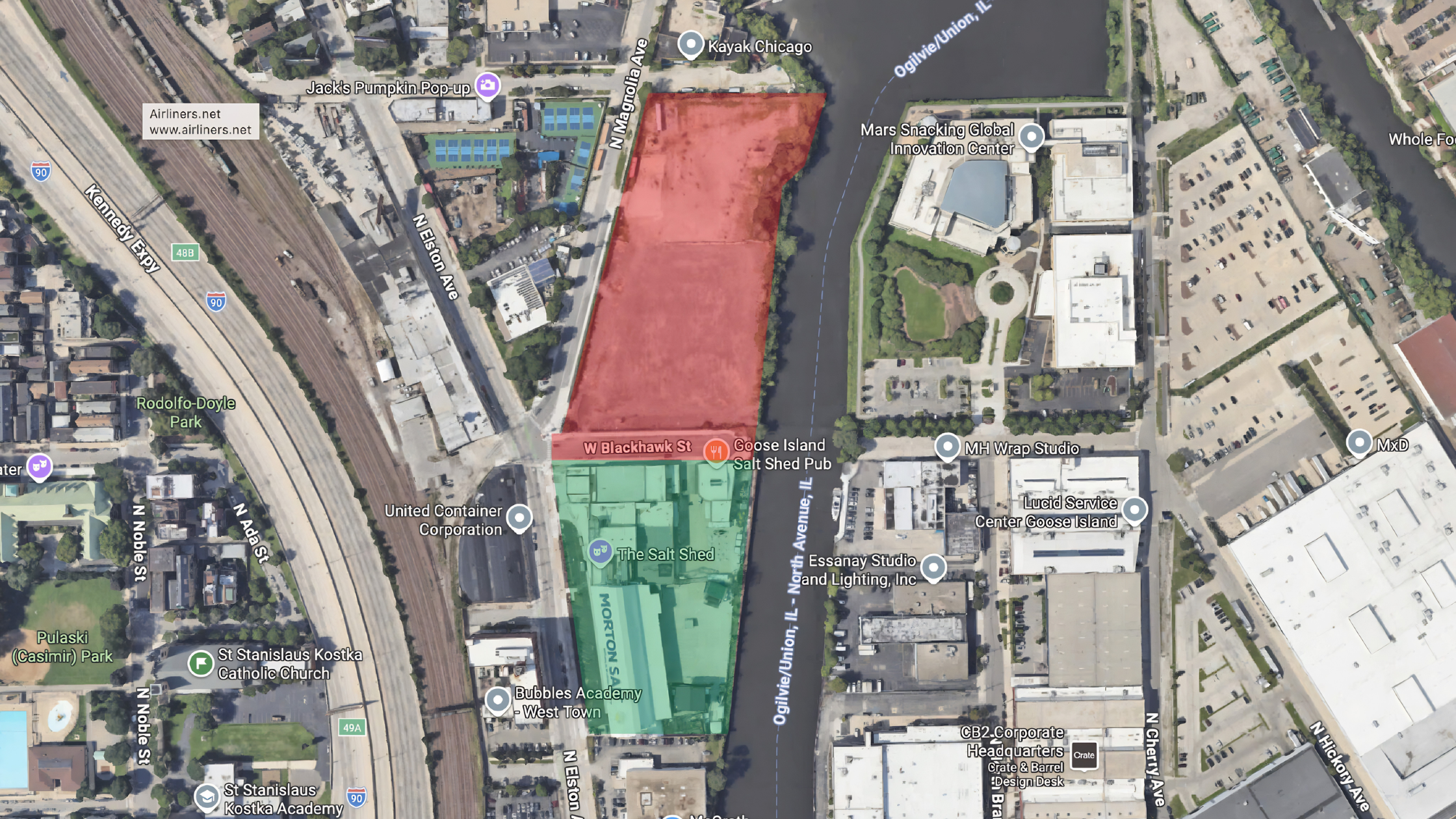
Existing Salt Shed (green) – Upcoming expansion (red) via Google Maps
Current plans show three sloped, grass-covered seating areas topped by larger general-admission decks. A lawn would extend toward the stage with a central bar, while a smaller section of assigned seating and elevated VIP areas would provide other viewing options.
The project also calls for new restrooms and guest facilities, backstage and artist areas, production space and a loading area accessible from Magnolia Avenue. More than 100 parking spaces are shown behind the venue.
One number is deliberately still uncertain: capacity.
Earlier planning discussions envisioned an outdoor venue capable of accommodating as many as 15,000 people, considerably larger than The Salt Shed’s current outdoor operation. But the newly revealed zoning plans do not establish a final capacity, so 15,000 should still be treated as an earlier concept rather than a confirmed figure.
The Plaza and Riverwalk Could Matter Just as Much as the Stage
The proposed expansion is not designed as an isolated concert lawn.
Plans call for removing a portion of Blackhawk Street and replacing it with a large plaza connecting the new property with the existing Salt Shed campus. Blackhawk is already closed during some events for queuing and security, so the proposal would formalize that space as part of the larger complex.
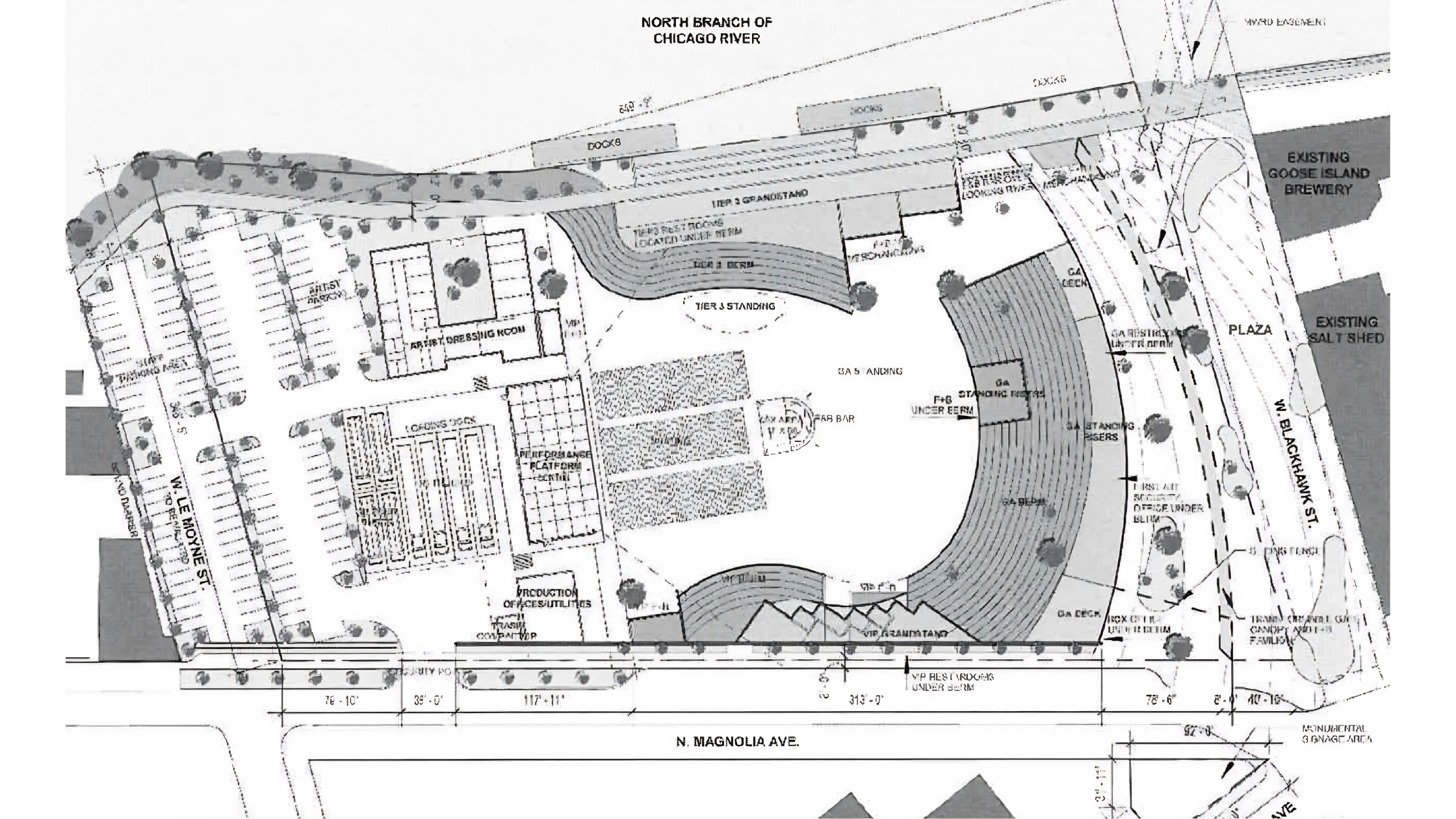
Site map of Salt Shed Expansion
From there, visitors could reach a new public riverwalk and boat dock along the Chicago River.
That is an important distinction.
A concert venue serves people primarily when something is happening onstage. A publicly accessible waterfront can potentially give people another reason to use the property outside of showtime.
Chicago has increasingly treated its rivers as public spaces rather than the backs of industrial properties. The original Salt Shed redevelopment already incorporated riverfront uses, and city planning requirements along the North Branch have placed increasing emphasis on public access and continuous waterfront connections.
If completed as proposed, the new riverwalk would extend that idea farther north.
The Salt Shed Already Proved an Industrial Site Could Become a Destination
To understand why the expansion matters, it helps to remember what stood here before.
The existing Salt Shed occupies the former Morton Salt complex at 1357 N. Elston Avenue. The industrial operation dated to 1929 and continued using the property until operations ceased in 2015.
The redevelopment team preserved the recognizable warehouse and Morton Salt identity while converting the site into an indoor and outdoor entertainment complex. The outdoor portion began hosting shows in 2022, followed by the indoor Shed in 2023.
Today, visitors do more than attend concerts.
The complex includes food and beverage operations, bars and locally oriented retail, while its outdoor Fairgrounds sits against the Chicago River. The venue itself describes the property as a broader creative and community space built around live music.
That adaptive reuse helped turn a recognizable industrial landmark into a place people intentionally visit.
The new proposal asks what happens if that concept expands across a much larger stretch of riverfront.
What Happens Next?
For now, this remains a proposal.
The zoning application covering 1401-1459 N. Magnolia Avenue was introduced October 14 and remains under consideration. The project will need city approvals, while substantial infrastructure work would also be required before construction could begin.
There is no announced construction start or opening date.
Even the scale has evolved since the concept first surfaced. In 2025, development discussions referenced the acquisition of more than five acres and an estimated investment of roughly $60 million to $70 million, while the latest plans show a broader site and considerably more detail.
That makes the next stages worth following closely.
Because if the project ultimately moves ahead, the biggest change may not simply be that The Salt Shed can host larger concerts.
It could create another significant piece of publicly accessible Chicago riverfront while pushing the North Branch farther from its industrial-only past and toward a mix of entertainment, recreation and neighborhood uses.
Watching Chicago’s North Branch Change?
Major developments can change how residents experience a neighborhood long before they show up in comparable sales.
The Cory Tanzer Group at Option Premier helps buyers and sellers evaluate nearby development, transportation, public spaces, neighborhood amenities and current market activity when deciding where a property fits into Chicago’s changing landscape.
Understanding what exists today matters.
Knowing what is proposed, approved and actually under construction nearby matters too.
Stay Connected
Ranked among the top 1% of real estate teams in the Chicagoland market, The Cory Tanzer Group at Option Premier is recognized for proven sales performance, neighborhood expertise, and consistent results across Chicago and the surrounding suburbs.
In the 2026 RealTrends Verified rankings, based on 2025 sales data, the team completed 181 transaction sides representing $79.28 million in sales volume. The Cory Tanzer Group ranked No. 13 in Illinois by transaction sides, No. 20 in Illinois by sales volume, No. 270 nationally by transaction sides, and No. 439 nationally by sales volume.
The team also earned The CARLY, the highest honor for Platinum Sales Dollars and Platinum Units Sold, at the Chicago Association of REALTORS® Sales Awards.
Led by Cory Tanzer, the team helps buyers, sellers, investors, landlords, and renters navigate real estate across Downtown Chicago, the North Shore, and the Western Suburbs, with local expertise in University Village, University Commons, South Loop, West Loop, Little Italy, Pilsen, and surrounding Chicagoland communities.
Connect with The Cory Tanzer Group at Option Premier for trusted local market insight, personalized guidance, and a proven strategy for your next Chicago real estate move.