Chicago Condo Buyers Face New Financing Rules. Could Your Building Still Qualify in 2027?

CHICAGO: When you buy a condo, your lender is not only approving you.
It may also need to approve the building.
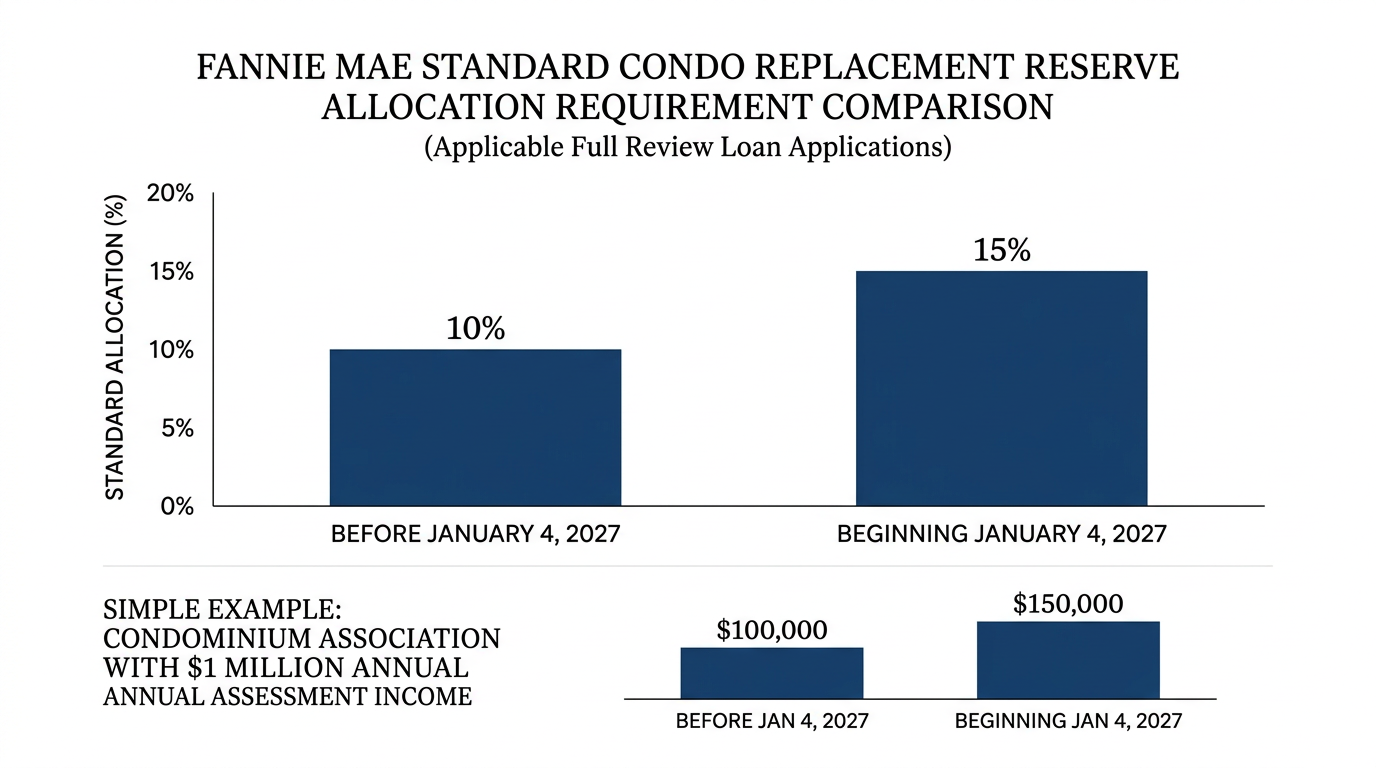
That distinction is becoming even more important for Chicago buyers. Fannie Mae has already retired its Limited Review process for loan applications dated on or after August 3, 2026, pushing many condo loans toward a more detailed Full Review. Then on January 4, 2027, another major change takes effect: the standard Full Review requirement for money budgeted toward replacement reserves will increase from 10% to 15% of annual assessment income. (Fannie Mae)
For buyers looking in condo-heavy markets such as South Loop, University Commons, University Village, West Loop, River North or Streeterville, that means the question before making an offer should not simply be:
Can I qualify for the mortgage?
It should also be:
Can this building qualify for the mortgage I plan to use?
The First Change Has Already Happened
Until this summer, some loans in established condo projects could qualify through Fannie Mae's Limited Review process, which required a narrower project review under certain circumstances.
That option is now gone.
For applications dated August 3, 2026 or later, projects previously eligible for Limited Review generally need to go through Full Review or qualify for one of Fannie Mae's remaining Waiver of Project Review options. Those waivers apply only in specific situations, including certain smaller projects and loan types.

For many buyers in larger Chicago condo buildings, the practical result is straightforward:
the association's finances, physical condition and project documentation matter more during financing than they may have under the old Limited Review route.
Under Full Review, lenders look at issues including the HOA budget, reserve funding, assessment delinquencies, insurance, project condition and characteristics that could make the project ineligible. Fannie Mae currently limits the percentage of units that can be 60 days or more delinquent on regular HOA assessments to 15%, with a similar test applied separately to special assessments.
The Bigger Change Arrives January 4
Today, the standard Full Review test generally requires an association to budget at least 10% of annual assessment income toward replacement reserves for capital expenditures and deferred maintenance.
Starting with Full Review loan applications dated January 4, 2027 or later, that minimum rises to 15%.
Consider a simplified example.
If a condo association collects $1 million per year in regular assessment income, the standard reserve allocation would move from at least $100,000 to $150,000.
That does not mean every Chicago condo association must immediately raise assessments by 5%. Associations have different budgets, existing reserve contributions and financial structures.
It also does not automatically mean a project budgeting less than 15% becomes impossible to finance.
Fannie Mae allows lenders, under specific conditions, to use an acceptable reserve study instead of relying solely on the standard percentage calculation. The study must support adequate reserves, and the association's budget must fund at least the highest recommended reserve allocation contained in that study. Fannie Mae also eliminated the ability to use a baseline funding approach that lets reserves approach zero as justification for avoiding its standard reserve requirement.
The takeaway for buyers is not that every association needs exactly 15% sitting in a bank account.
It is that reserve planning and documentation are becoming harder to ignore.
What Should Chicago Condo Buyers Check Before Making an Offer?
You do not need to personally underwrite the association. That is ultimately the lender's responsibility.
But discovering a financing problem after attorney review, inspection and appraisal is not ideal either.
Before committing to a condo, ask your agent and lender what association information can reasonably be reviewed early. Depending on the property and what is available, useful documents can include:
the current HOA budget and amount allocated to reserves
the most recent reserve study, if one exists
current and planned special assessments
recent association meeting minutes
information about major upcoming repairs or deferred maintenance
the building's master insurance coverage
information about pending litigation
HOA delinquency information
the completed condo questionnaire, if already available
Fannie Mae's standardized Condominium Project Questionnaire, Form 1076, is specifically designed to help lenders collect project information from HOAs, although use of that exact form is optional.
Buyers should also involve the lender early.

A loan officer familiar with Chicago condos may be able to determine whether the building has already been reviewed, whether additional documentation will be required and whether anything about the project could delay underwriting.
Fannie Mae also now offers a public Condo Status Finder, which can identify certain project eligibility information. Fannie Mae says some of the most common reasons projects receive an ineligible status include insufficient master property insurance and critical repair issues, with litigation and certain short-term rental characteristics also appearing among common problems.
Do Not Wait Until Closing to Find Out
The January 2027 change does not mean buyers should avoid older condo buildings or associations that currently allocate less than 15% to reserves.
It means buyers, agents and lenders should be asking better questions earlier.
Fannie Mae's own condo guidance emphasizes that lenders evaluate whether a project is financially stable, appropriately insured and free from unresolved conditions affecting safety, structural integrity or habitability.
And that is ultimately the bigger lesson behind these new rules.
You can have excellent credit, strong income and a large down payment and still encounter financing problems if the condo project itself does not satisfy the loan program's requirements.
For Chicago buyers heading into 2027, checking the building before becoming emotionally committed to the unit could save considerable time later.
Buying a Chicago Condo in 2027? Review the Building Before You Write the Offer
Condo financing is increasingly about more than the buyer's credit score and down payment.
The Cory Tanzer Group at Option Premier helps buyers compare HOA assessments, reserves, special assessments, recent building sales, parking, association issues and lender considerations when evaluating condos across Chicago.
That is particularly important in South Loop, University Commons, University Village and West Loop, where buyers may be choosing among multiple buildings with very different financial profiles.
The right condo is not simply the unit you can afford.
It is the unit in a building your financing can work with, too.
Stay Connected
Ranked among the top 1% of real estate teams in the Chicagoland market, The Cory Tanzer Group at Option Premier is recognized for proven sales performance, neighborhood expertise, and consistent results across Chicago and the surrounding suburbs.
In the 2026 RealTrends Verified rankings, based on 2025 sales data, the team completed 181 transaction sides representing $79.28 million in sales volume. The Cory Tanzer Group ranked No. 13 in Illinois by transaction sides, No. 20 in Illinois by sales volume, No. 270 nationally by transaction sides, and No. 439 nationally by sales volume.
The team also earned The CARLY, the highest honor for Platinum Sales Dollars and Platinum Units Sold, at the Chicago Association of REALTORS® Sales Awards.
Led by Cory Tanzer, the team helps buyers, sellers, investors, landlords, and renters navigate real estate across Downtown Chicago, the North Shore, and the Western Suburbs, with local expertise in University Village, University Commons, South Loop, West Loop, Little Italy, Pilsen, and surrounding Chicagoland communities.
Connect with The Cory Tanzer Group at Option Premier for trusted local market insight, personalized guidance, and a proven strategy for your next Chicago real estate move.