What Documents Do You Need to Sell a Chicago Condo?

Selling a condo involves something a single-family home seller usually does not have to deal with: your transaction depends partly on paperwork controlled by your condo association or management company.
A buyer may want to review the building's finances, reserves, rules, insurance, upcoming projects and litigation before moving forward. If the buyer is financing, their lender may conduct a separate review of the condominium association.
And in Illinois, Section 22.1 of the Illinois Condominium Property Act creates specific resale disclosure requirements for condo owners.
That is why one of the best things a Chicago condo seller can do is start gathering association information before a buyer is already waiting for it.
Here are the documents that commonly matter and where Chicago condo sales can get slowed down.
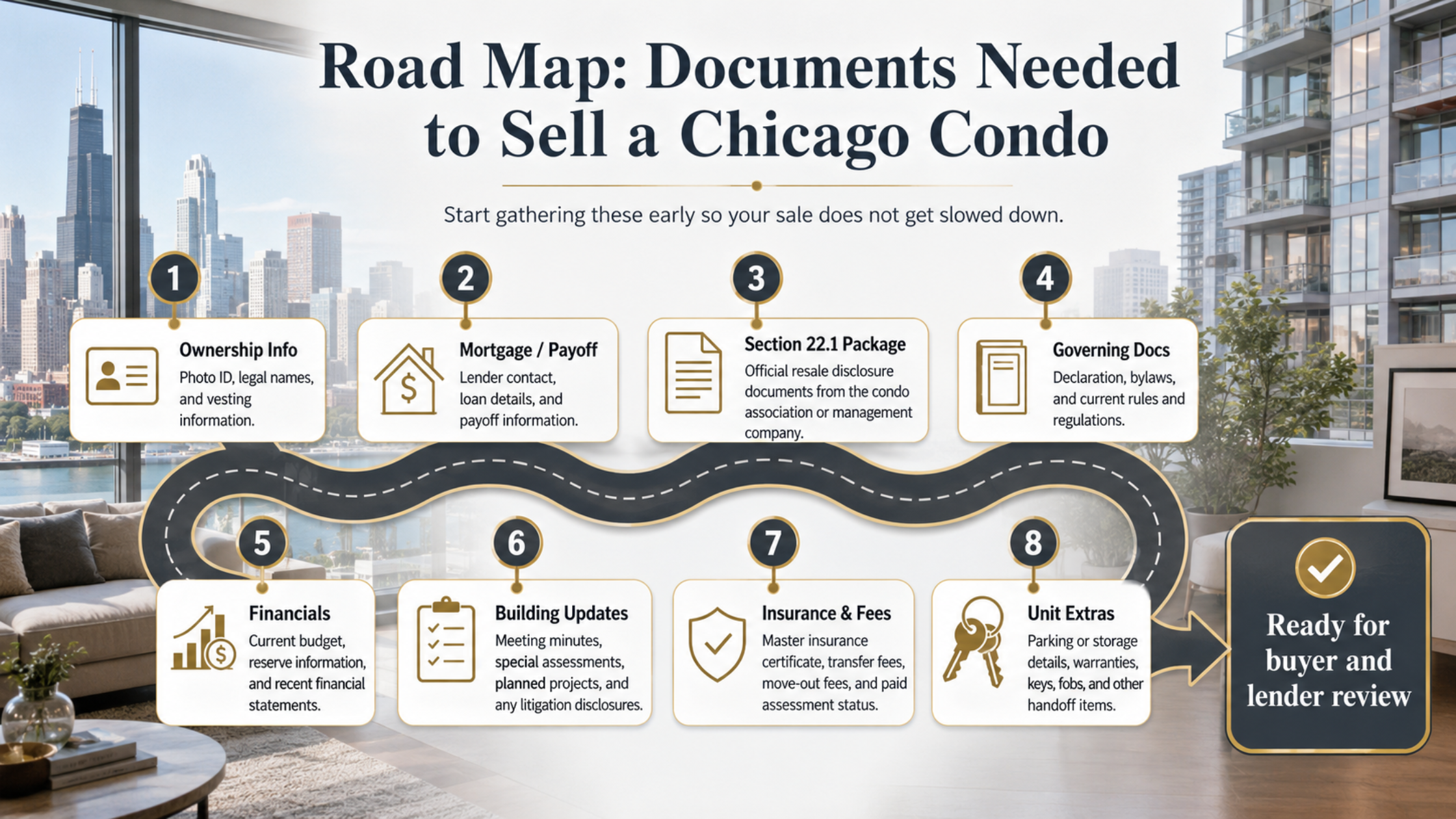
1. Start With Your Condo Declaration, Bylaws and Rules
These are the documents that establish how the condominium operates.
A typical package may include:
Condominium declaration
Bylaws
Rules and regulations
Amendments to the governing documents
Section 22.1 specifically requires a resale seller, upon a prospective purchaser's demand, to obtain from the association and make available the declaration, bylaws, other condominium instruments, rules and regulations.
These documents can affect issues buyers care about well beyond monthly assessments.
Depending on the building, they may address leasing restrictions, pets, remodeling, move-in procedures, parking, use of common areas and other ownership rules.
Chicago condo sellers should not assume the PDF saved from when they purchased the unit years ago is still current. Associations can amend their documents, so obtaining the latest set from management is safer.
2. Understand the Illinois 22.1 Disclosure
For Chicago condo sellers, Section 22.1 documents are one of the most important pieces of the transaction.
Under the Illinois Condominium Property Act, the seller of a resale condominium must obtain certain information from the Board of Managers and make it available to a prospective purchaser upon demand.
The statutory information includes:
Governing documents and association rules
Any liens, unpaid assessments or other authorized charges against the unit
Capital expenditures anticipated during the current or next two fiscal years
The status and amount of the association's replacement reserves
The association's most recently available financial statement
Pending lawsuits or judgments involving the association
Association-provided insurance coverage
Information concerning alterations to the unit or its limited common elements
Contact information for the association's designated officer or agent
This is much more than administrative paperwork.
A buyer reviewing a 22.1 package may discover an upcoming roof replacement, elevator project, pending lawsuit, weak reserves or unpaid assessments associated with the unit. Those issues can affect whether the buyer proceeds, renegotiates or asks more questions during attorney review.
3. Don't Wait Until the Last Minute to Request the 22.1 Package
Timing matters.
Illinois law gives the association's designated officer 10 business days after receiving a written request to furnish the Section 22.1 information. The law also permits an association to charge a statutorily limited fee for producing the package and an additional fee of up to $100 for qualifying rush service completed within 72 hours.
Ten business days can consume a meaningful part of a Chicago condo transaction if nobody begins the process until a buyer's attorney asks for the package.
In practice, the seller, real estate agent and attorney may coordinate with the association or property management company depending on how that particular building handles resale requests.
The key point for sellers is simple:
Know how your association orders resale documents before you need them.
Ask who handles the request, what it costs, which portal is used and how long the building typically takes.
4. Gather the Budget, Financials and Reserve Information
Building finances have become an especially important part of condominium transactions.
A buyer wants to know whether an association appears capable of maintaining the property without constantly turning to owners for unexpected assessments.
Section 22.1 specifically calls for information about replacement reserves, anticipated capital expenditures and the association's most recently available financial condition.
Depending on the transaction and lender, additional documents may include:
Current association budget
Financial statements
Reserve study
Insurance information
Details of major repair projects
If the buyer is obtaining a mortgage, the lender may conduct its own condo-project review. Fannie Mae's current project standards say documentation used in those reviews may include budgets, financial statements, reserve studies, legal documents, insurance information and condominium questionnaires.
This means a condo sale can be perfectly acceptable to the buyer personally while still generating questions from the buyer's lender about the building as a whole.
5. Have Recent Board Meeting Minutes Available
Board minutes can be particularly revealing because they show what the association has actually been discussing.
They may contain information about:
Proposed repairs
Building maintenance
Special assessments
Insurance issues
Major contracts
Resident concerns
Capital projects
Litigation discussions when appropriate for disclosure
One useful Chicago-specific detail is that board minutes are not separately listed among the nine disclosure categories in Section 22.1 itself.
However, the Chicago Association of REALTORS®' Exclusive Right to Sell Listing Agreement instructs a condo seller using that agreement to provide the brokerage with a complete set of condo documents including the declaration, bylaws, rules, regulations, budget and meeting minutes within 15 days after execution of the listing agreement.
That is another reason to start collecting documents at listing time instead of treating them solely as a post-contract problem.
6. Know the Status of Any Special Assessment
If your building has a special assessment, buyers will want details.
Be prepared to explain:
Total special assessment amount
Your unit's share
Remaining balance
Payment schedule
Purpose of the project
Whether the assessment has already been approved
Whether additional work or assessments are being discussed
The current Chicago Association listing form specifically asks sellers whether they know of a proposed special assessment, the total amount, remaining balance and payment schedule. It also instructs sellers to keep their brokerage informed of board actions and changes to that information.
Do not wait for a buyer to discover an assessment in board minutes that was never discussed during the listing process.
Whether an assessment balance is paid by the seller, assumed by the buyer or otherwise addressed is a transaction-specific issue that should be handled in the contract and with the parties' attorneys.
7. The Paid Assessment Letter Is Different From the 22.1 Disclosure
These two documents are sometimes discussed together, but they serve different purposes.
The Section 22.1 information includes a statement regarding unpaid assessments and other charges owed by the unit.
A Paid Assessment Letter, often called a PAL, is typically obtained closer to closing and confirms the status of the unit's association assessments.
The Chicago Association listing agreement says a condo seller should furnish the buyer with a statement from an authorized association representative certifying payment of common-expense assessments.
Attorneys' Title Guaranty Fund's Illinois Residential Closing Document Checklist separately identifies all of the following for condo and townhouse closings:
22.1 Disclosure, condo governance documents, Paid Assessment Letter and applicable Right of First Refusal documentation.
So ordering a 22.1 package does not necessarily mean every document needed for closing has already been handled.
8. Check Whether Your Building Has a Right of First Refusal
Some Chicago condominium declarations contain a Right of First Refusal, or ROFR.
The exact procedure depends on the building's governing documents. Where applicable, documentation showing that the right has been waived or otherwise satisfied may be needed before ownership can transfer.
Both the Chicago Association listing agreement and ATG's Illinois closing checklist identify applicable Right of First Refusal documentation as part of the condo-sale process.
This is one of those building-specific details a seller may not remember from the original purchase.
Check early rather than learning about it days before closing.
9. Expect a Condo Questionnaire If the Buyer Is Financing
A condo questionnaire is not the same thing as the Section 22.1 disclosure.
The 22.1 package exists because of Illinois resale law.
A condominium questionnaire is generally connected to the buyer's lender and its evaluation of the overall project.
Fannie Mae says its standardized Condominium Project Questionnaire, Form 1076, can help lenders collect information necessary to determine project eligibility, although the form itself is optional and lenders may use a substantially similar questionnaire.
The lender may be looking at issues involving the association's:
Budget
Reserves
Insurance
Ownership structure
Property condition
Litigation
Major repairs
Other project-level risks
That is why a buyer can be financially qualified for the mortgage but still encounter a problem with condo project approval.
The seller usually cannot solve an association-level lending problem overnight. Knowing your building's financial and insurance situation before listing can reduce surprises.
10. Document Your Parking and Storage Correctly
Chicago condo sales can get surprisingly complicated when parking or storage is described incorrectly.
Parking may be:
Separately deeded
A limited common element
Assigned
Indoor
Outdoor
Storage may also be deeded, assigned or treated as a limited common element.
The Chicago Association listing agreement specifically asks sellers to identify the parking space number, storage space number and ownership structure.
If parking has its own deed or separate Property Index Number, make sure everyone knows that before the property goes live.
The same applies to storage.
A listing that says “parking included” is not enough if the legal documents tell a more complicated story.
11. Gather Your Unit-Specific Seller Disclosures
Association documents describe the building.
You still need documents relating to your individual condo.
Illinois' Residential Real Property Disclosure Act expressly includes condominium units and their applicable limited common elements within its definition of residential real property.
Depending on the property and circumstances, seller paperwork may also involve items such as:
Illinois Residential Real Property Disclosure Report
Radon disclosure
Lead-based paint disclosure for applicable older properties
Chicago-specific disclosures or certifications
Information regarding improvements or renovations
The Chicago Association's listing agreement also references several of these items for residential properties in Chicago and asks condo sellers to provide information about the management company, monthly assessment and special assessments.
Your agent and attorney should determine which forms apply to your specific sale.
12. If the Condo Is Rented, Add the Lease Documents
Selling a tenant-occupied Chicago condo creates another layer of paperwork.
At minimum, you may need to locate:
The current lease
Amendments or renewals
Security-deposit information, if applicable
Rent records
Tenant notices
Building lease restrictions
ATG's Illinois closing checklist separately identifies existing leases and related tenant-transfer documents where applicable.
Chicago landlord-tenant requirements can also affect notice and access during a sale, so tenant-occupied properties should be addressed with the agent and attorney early in the listing process.
What Should You Gather Before Listing a Chicago Condo?
You may not need the final version of every closing document on Day One.
But before listing, it is helpful to know where to obtain:
Association documents
Declaration
Bylaws
Rules and regulations
Current budget
Recent board minutes
Association financial information
Unit information
Current monthly HOA assessment
Special assessment details
Parking documentation
Storage documentation
Management-company contact
Lease documents if occupied by a tenant
Transaction documents
Section 22.1 ordering instructions
Paid Assessment Letter procedures
Right of First Refusal requirements, if applicable
Condo questionnaire process and fees
The goal is not to order every document unnecessarily months before a sale.
It is to avoid discovering after accepting an offer that management needs 10 business days, the seller has the wrong parking documentation or nobody knows how to order the association's resale package.
Selling a Chicago Condo? Start With the Building Paperwork Before You List
Pricing, photography and staging matter, but a successful Chicago condo sale also depends on understanding the association behind the unit.
Before listing, sellers should know their building's assessment history, reserves, special assessments, rules, resale-document procedures, parking structure and management contacts.
The Cory Tanzer Group at Option Premier helps Chicago condo sellers prepare for those building-specific issues early, whether the property is in South Loop, West Loop, University Village, University Commons, River North, Streeterville or another Chicago neighborhood.
Starting the paperwork before an offer arrives can mean fewer surprises once attorney review, financing and closing begin.
This article is for general informational purposes and is not legal advice. Condominium documents and transaction requirements vary by building and sale. Sellers should consult their Illinois real estate attorney regarding their specific transaction.
Stay Connected
Ranked among the top 1% of real estate teams in the Chicagoland market, The Cory Tanzer Group at Option Premier is recognized for proven sales performance, neighborhood expertise, and consistent results across Chicago and the surrounding suburbs.
In the 2026 RealTrends Verified rankings, based on 2025 sales data, the team completed 181 transaction sides representing $79.28 million in sales volume. The Cory Tanzer Group ranked No. 13 in Illinois by transaction sides, No. 20 in Illinois by sales volume, No. 270 nationally by transaction sides, and No. 439 nationally by sales volume.
The team also earned The CARLY, the highest honor for Platinum Sales Dollars and Platinum Units Sold, at the Chicago Association of REALTORS® Sales Awards.
Led by Cory Tanzer, the team helps buyers, sellers, investors, landlords, and renters navigate real estate across Downtown Chicago, the North Shore, and the Western Suburbs, with local expertise in University Village, University Commons, South Loop, West Loop, Little Italy, Pilsen, and surrounding Chicagoland communities.
Connect with The Cory Tanzer Group at Option Premier for trusted local market insight, personalized guidance, and a proven strategy for your next Chicago real estate move.