More Out-of-Towners Are Searching for Chicago Rentals: Is a New Relocation Wave Coming?

CHICAGO— More people outside the Chicago area appear to be looking at the city as a potential place to live.
A new Zillow analysis of rental search patterns found that 30.9% of page views on Chicago rental listings came from people outside the Chicago metro area. Even more notable, Chicago's share of out-of-town rental interest increased 3.7 percentage points from a year earlier, the second-largest increase among the major metros Zillow analyzed. Only Buffalo recorded a larger increase.
That does not mean nearly one-third of Chicago renters are moving here from another city.
It does suggest something worth watching:
More people outside Chicago are actively considering Chicago rentals than they were a year ago.
And because renting is often the first step for someone relocating to an unfamiliar city, the increase could be an early signal of future relocation demand.
Chicago Had One of the Largest Increases in Out-of-Town Rental Interest
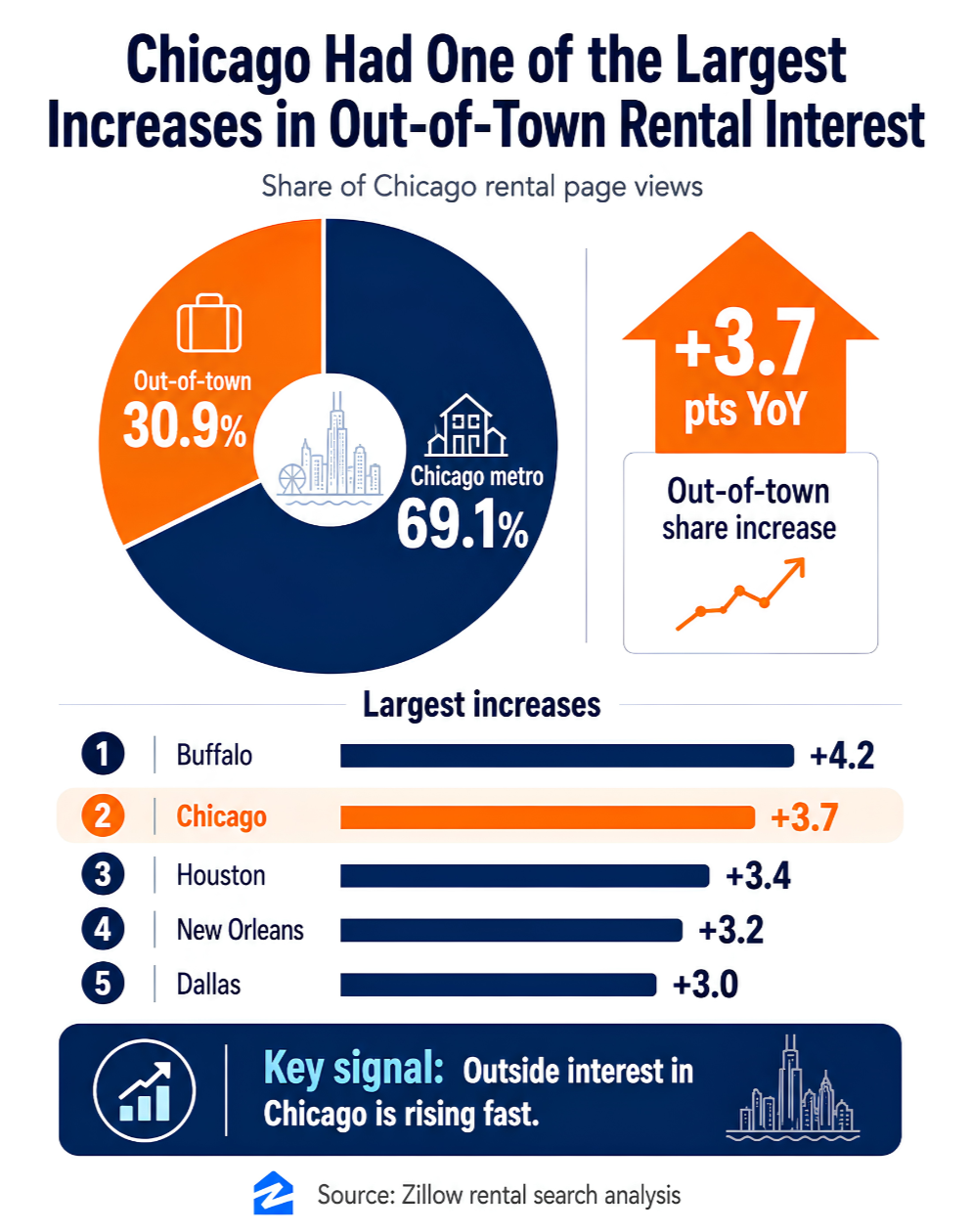
Zillow analyzed rental listing page views to understand where prospective renters were shopping outside their current metropolitan areas.
Chicago stood out.
Out-of-town shoppers accounted for 30.9% of Chicago rental page views, compared with approximately 69.1% from people already within the Chicago metro.
More importantly, the outside share increased 3.7 percentage points year over year.
The largest increases were:
Buffalo: +4.2 percentage points
Chicago: +3.7
Houston: +3.4
New Orleans: +3.2
Dallas: +3.0
Zillow described growing outside search activity as an early signal of where relocation demand may be developing.
Chicago is therefore not the market with the largest percentage of outside renters searching.
In fact, Chicago remains one of the most locally driven rental markets because of the size of its existing population.
What makes the 2026 numbers interesting is the direction of change.
Outside interest is increasing quickly.
Does This Mean a Chicago Relocation Wave Is Coming?
Not necessarily.
Search activity and actual migration are two different things.
Someone in another city might look at a Chicago apartment because they are:
Considering a job offer
Comparing cost of living
Thinking about graduate school
Planning a future move
Exploring neighborhoods
Comparing Chicago with another city
Helping a family member relocate
Simply curious about what their housing budget could buy
A rental page view does not equal a signed lease.
But search behavior can happen months before an actual move, which is why the trend is worth watching.
Zillow specifically noted that increasing outside rental interest can point toward a developing pipeline of incoming renters.
For Chicago, a 3.7-point annual increase is substantial enough to suggest the city is appearing on more relocation shortlists.
Where Are Chicago's Out-of-Town Rental Shoppers Coming From?
The largest single outside source of Chicago rental page views was Milwaukee, accounting for approximately 1.4% of all Chicago rental listing page views in Zillow's analysis.
That fits a broader pattern Zillow identified.
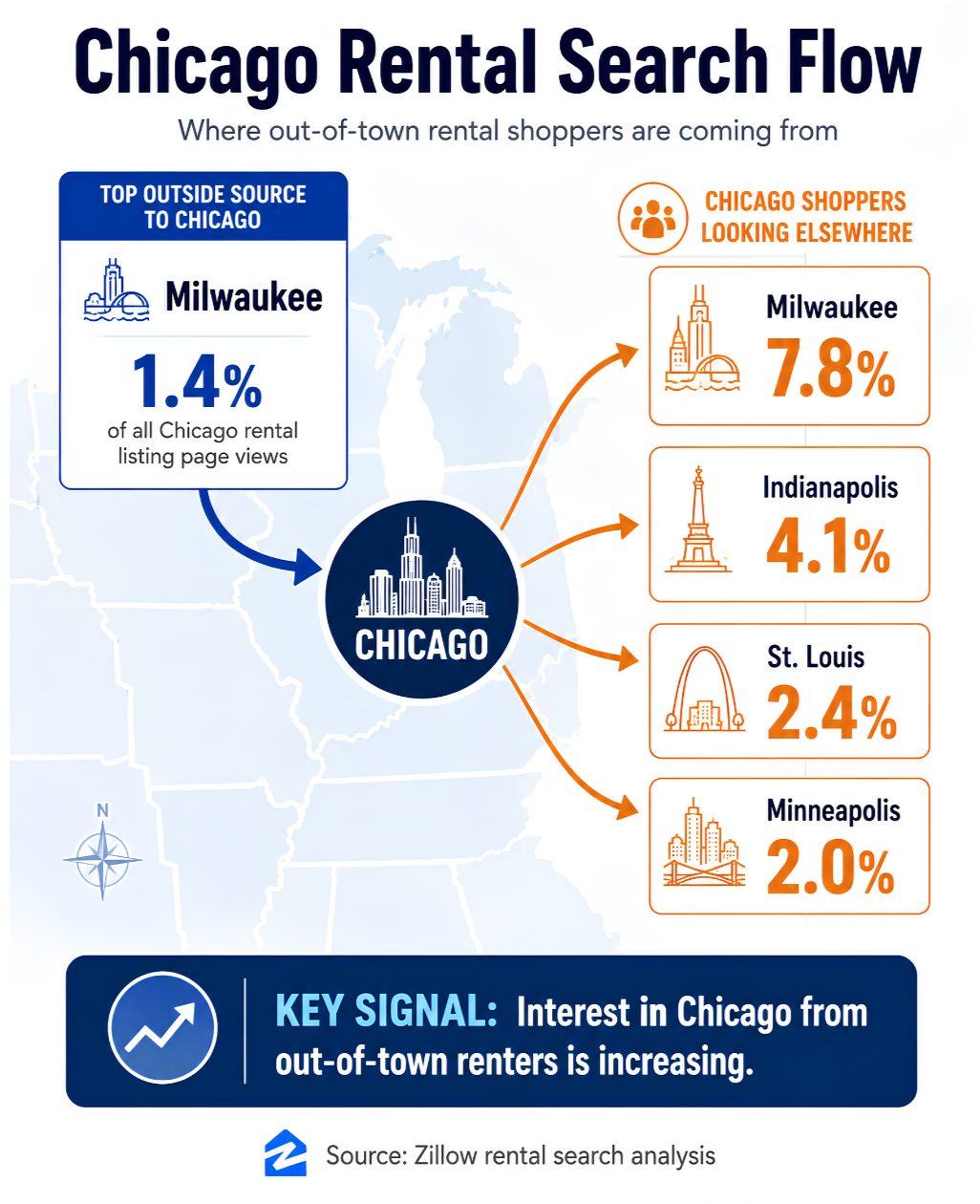
Many cross-metro rental searches happen between nearby metropolitan areas, where relocating may involve a relatively manageable move while still giving someone access to a substantially different employment, housing or lifestyle market.
Chicago also sends rental search traffic in the opposite direction.
For example, Chicago shoppers represented:
7.8% of Milwaukee rental page views
4.1% of Indianapolis rental page views
2.4% of St. Louis rental page views
2.0% of Minneapolis rental page views
People are clearly comparing Midwestern cities in both directions.
The important Chicago signal is that the percentage looking into Chicago is increasing.
Why Renting First Can Make Sense When Moving to Chicago
Relocating to Chicago is very different from moving across town.
Someone arriving from New York, California, another Midwestern city or elsewhere in the country may know they want Chicago without knowing exactly which version of Chicago fits them.
Consider how different these choices can be:
West Loop: restaurants, Fulton Market, newer luxury apartments and lofts.
South Loop: high-rises, lake access, parks and easier access to Downtown.
River North: dense urban living, nightlife and extensive high-rise inventory.
Streeterville: lakefront and luxury high-rise living close to Michigan Avenue.
Lakeview: neighborhood streets, nightlife, lake access and a large rental inventory.
Lincoln Park: residential streets, parks, restaurants and a mix of apartments, condos and single-family homes.
University Village and Little Italy: proximity to UIC, Taylor Street and the Near West Side.
And that only covers a small portion of the city.
A renter can spend a year learning:
Their actual commute
Which CTA lines they use
Where they spend weekends
Whether they need a car
How important lake access is
Whether they prefer a high-rise or neighborhood street
Where friends and family live
How much space they actually need
That information can be extremely valuable if the eventual goal is to buy.
Rent First, Buy Later Can Be a Relocation Strategy
Renting first should not automatically be viewed as delaying homeownership.
For someone new to Chicago, it can be part of the process of figuring out where to buy correctly.
Imagine someone relocating for work who initially thinks they want to live in River North.
After renting there for a year, they might discover they spend most weekends in West Loop and want to buy there instead.
Another person might arrive looking exclusively Downtown and eventually realize that a neighborhood farther north or a western suburb provides more space for the same budget.
Someone else might rent in South Loop and decide they want to remain in the neighborhood permanently.
Renting gives newcomers something an online neighborhood guide cannot:
firsthand experience living in Chicago.
But Renting First Is Not Automatically the Better Financial Choice
There is also a financial side to the decision.
According to Zillow's 2026 rent-versus-buy analysis, a typical Chicago homebuyer would need to remain in the home for approximately 6.5 years before buying financially breaks even with renting under the assumptions in Zillow's model.
Nationally, the break-even period was approximately six years in that analysis.
That does not mean every Chicago buyer should rent for six years.
It means the decision becomes heavily influenced by how long you expect to stay.
Someone relocating to Chicago who is unsure whether they will remain for two years may approach buying very differently from someone moving here with the expectation of staying for the next decade.
That is why one of the first relocation questions should be:
“How long do I realistically expect Chicago to be home?”
What Does the Chicago Rental Market Look Like Right Now?
As of September 2, 2026, Zillow reported an average Chicago rent of approximately $2,000 per month across all bedroom counts and property types.
The platform showed approximately 9,359 rentals available and classified Chicago's rental market as warm, based on renter demand relative to national conditions. (Zillow's Chicago rental market data)
The citywide average should be treated carefully.
It does not mean a renter should expect every Chicago apartment to cost $2,000.
Rent can vary dramatically based on:
Neighborhood
Bedroom count
Building age
Amenities
Parking
In-unit laundry
Outdoor space
New construction
Proximity to transit
Time of year
A luxury two-bedroom in Fulton Market and an older one-bedroom several neighborhoods away are part of the same citywide dataset but represent completely different rental markets.
For someone moving to Chicago, budgeting by neighborhood and housing type is far more useful than relying on one citywide average.
What This Could Mean for Chicago's Rental Market
If outside interest continues rising while local rental demand remains strong, certain neighborhoods could see additional competition for desirable rentals.
That will not affect every unit equally.
The strongest demand is generally concentrated around combinations of:
Competitive pricing
Transit access
Updated condition
In-unit laundry
Parking
Popular neighborhoods
Flexible move-in timing
Desirable building amenities
For landlords, growing relocation interest could expand the renter pool.
For renters, it makes early preparation more important, particularly when moving from another state and trying to secure an apartment remotely.
Moving to Chicago? Choose the Neighborhood Before You Choose the Apartment
The most interesting part of Zillow's latest data is not simply that 30.9% of Chicago rental listing views came from outside the metro.
It is that this share increased considerably in just one year.
That suggests more prospective renters are putting Chicago into consideration.
For people relocating here, renting first can provide flexibility while learning the city. For others who already know they expect to stay long term, starting with the homebuying process may make more sense.
There is no single correct path.
The better strategy is to compare where you want to live, how long you expect to stay, what you can comfortably spend and whether renting or buying better supports your move.
Start Your Chicago Move With a Local Plan
The Cory Tanzer Group at Option Premier helps people relocating to Chicago compare neighborhoods, rentals, condos, homes, transportation, housing costs and future buying options before committing to one part of the city.
If renting is the best first step, explore Chicago apartment and rental options.
If buying makes more sense, the team can help narrow the city and surrounding suburbs based on budget, commute, property type and the lifestyle you actually want after the move.
Stay Connected
Ranked among the top 1% of real estate teams in the Chicagoland market, The Cory Tanzer Group at Option Premier is recognized for proven sales performance, neighborhood expertise, and consistent results across Chicago and the surrounding suburbs.
In the 2026 RealTrends Verified rankings, based on 2025 sales data, the team completed 181 transaction sides representing $79.28 million in sales volume. The Cory Tanzer Group ranked No. 13 in Illinois by transaction sides, No. 20 in Illinois by sales volume, No. 270 nationally by transaction sides, and No. 439 nationally by sales volume.
The team also earned The CARLY, the highest honor for Platinum Sales Dollars and Platinum Units Sold, at the Chicago Association of REALTORS® Sales Awards.
Led by Cory Tanzer, the team helps buyers, sellers, investors, landlords, and renters navigate real estate across Downtown Chicago, the North Shore, and the Western Suburbs, with local expertise in University Village, University Commons, South Loop, West Loop, Little Italy, Pilsen, and surrounding Chicagoland communities.
Connect with The Cory Tanzer Group at Option Premier for trusted local market insight, personalized guidance, and a proven strategy for your next Chicago real estate move.