Offer Accepted in Chicago? Here's How Long It Takes to Close on a Home or Condo
CHICAGO— Your offer on a home has been accepted. Congratulations! But before you get the keys, there are several important steps between signing the contract and officially becoming a homeowner.
In Chicago, most financed home purchases take approximately 30 to 45 days to close after an offer is accepted. Some transactions take longer depending on mortgage approval, inspections, title work and other requirements.
Cash purchases can sometimes close in one to three weeks, provided the title is clear and the necessary legal documents are ready.
For first-time homebuyers, condo buyers and people relocating to Chicago, understanding what happens during those weeks can make the entire process easier to navigate.
How Long Does Closing Take After an Accepted Offer?
The closing timeline begins once both parties have signed and accepted the purchase contract.
Here's a general breakdown of what happens during a typical Chicago home purchase.
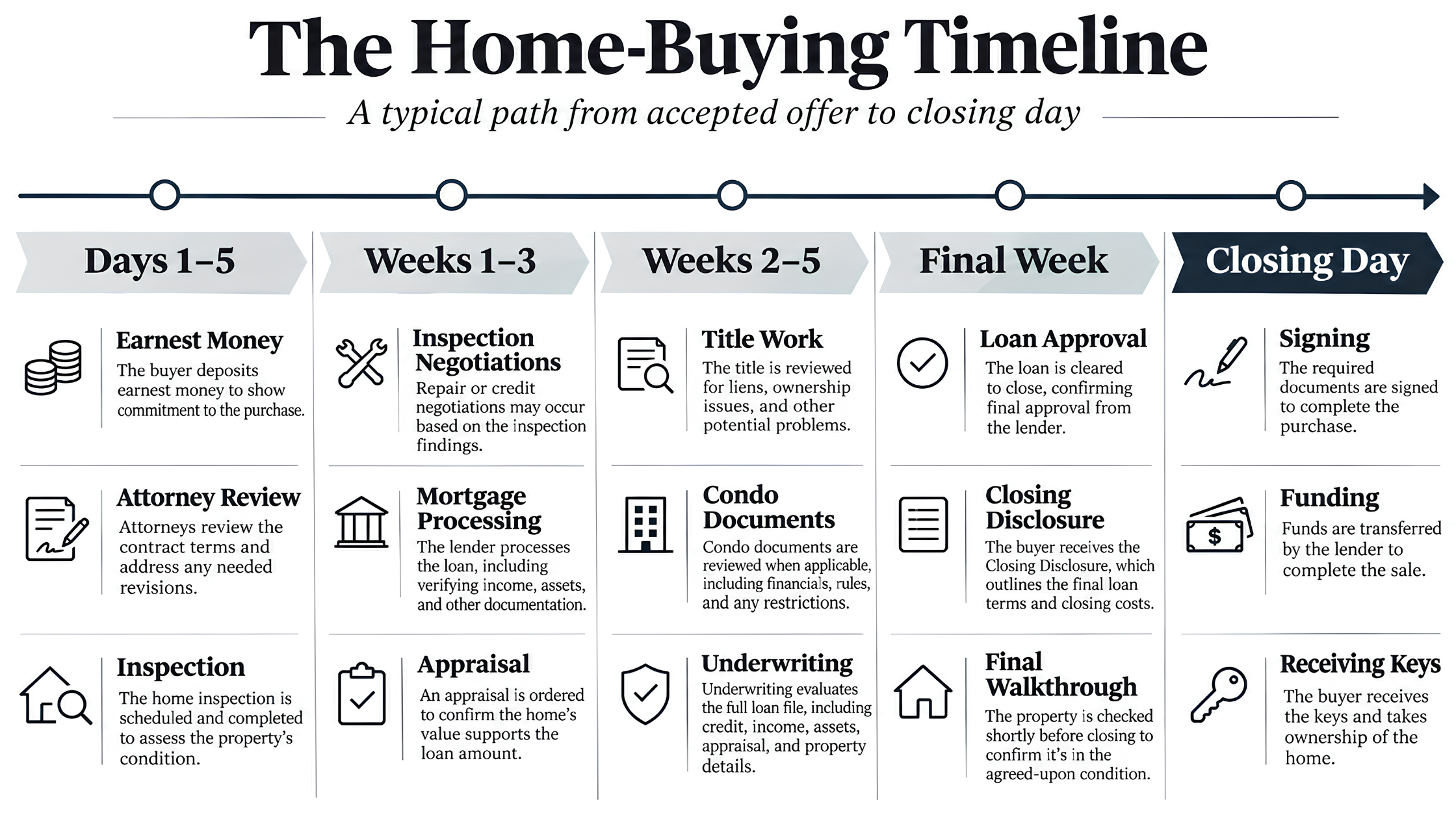
These are illustrative timeframes. Several steps happen simultaneously, and actual deadlines depend on the signed purchase contract.
A 30-day closing may be possible when financing and documentation move smoothly. However, buyers should avoid scheduling movers or ending a lease until their closing arrangements are sufficiently confirmed.
Step 1: Attorney Review and Home Inspection
After your offer is accepted, attorney review and inspections are usually among the first priorities.
Attorney Review
In Chicago-area transactions using the Multi-Board Residential Real Estate Contract 8.0, attorneys generally have five business days after acceptance to review the agreement and take permitted action.
Your attorney may address closing dates, financing provisions, property tax prorations and other contract terms.
This five-business-day period is a provision of that particular contract form, not a universal rule for every Illinois transaction. Your signed agreement determines the actual deadlines.

Home Inspection
Buyers typically schedule a professional inspection early in the process to evaluate the property's condition.
Inspectors may examine the roof, foundation, plumbing, electrical systems, HVAC equipment and other accessible components.
If the inspection identifies concerns, buyers may negotiate repairs, seller credits or other resolutions, depending on their contractual rights.
Inspection issues can sometimes delay closing, particularly when additional evaluations or significant repair negotiations are necessary.
Buyer tip: Schedule your inspection promptly after acceptance. Waiting too long could put important contractual deadlines at risk.
Step 2: Mortgage Approval, Appraisal and Title Work
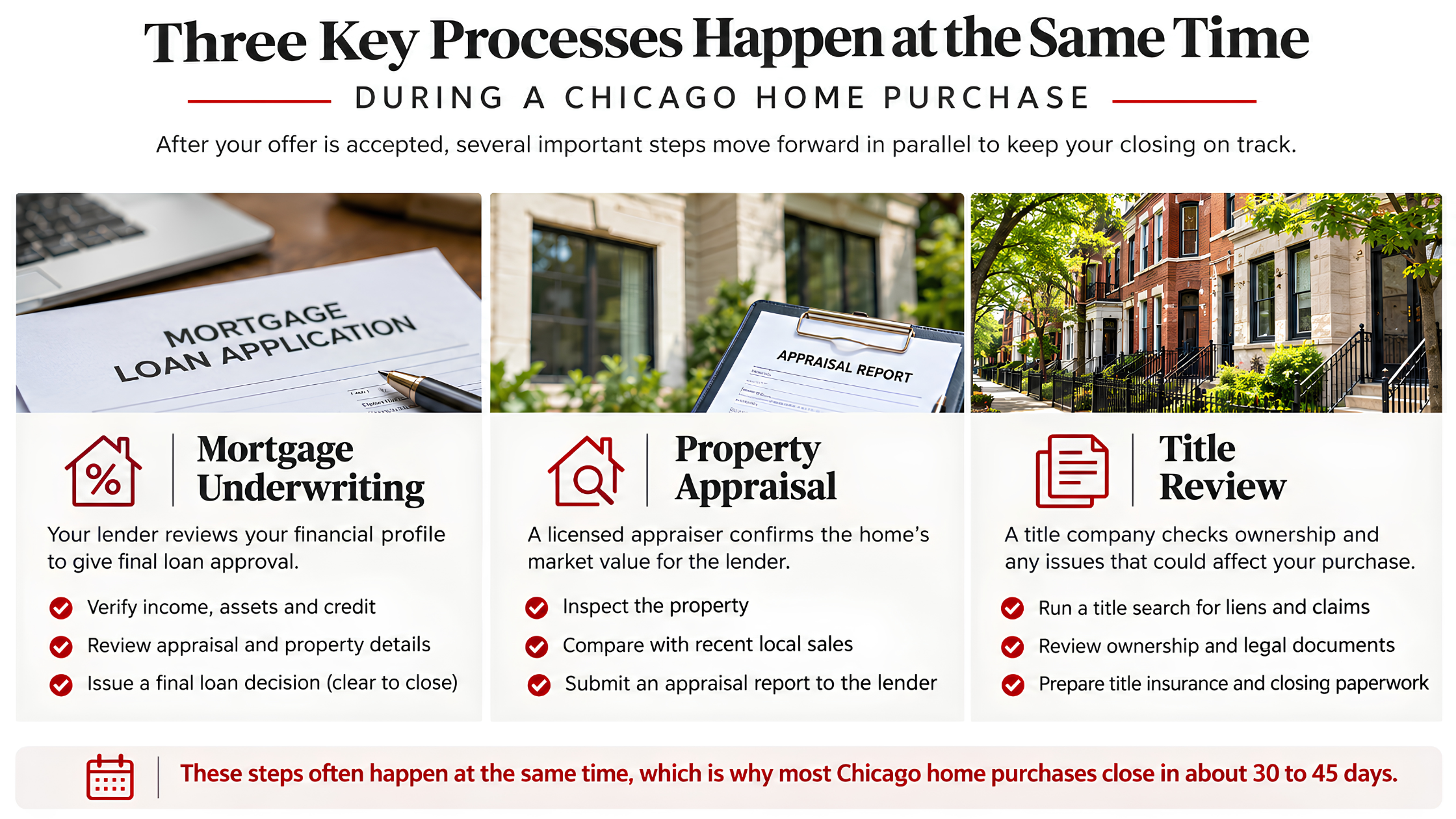
Once the contract is underway, several processes typically happen at the same time.
Mortgage Underwriting
Your lender reviews your financial information, including income, employment, assets, debts and credit.
Even if you received mortgage preapproval before making an offer, final underwriting is still required.
The lender may request updated bank statements, employment verification or explanations for certain financial transactions.
Avoid opening new credit accounts, financing major purchases or making unexplained large deposits without consulting your lender before closing.
Property Appraisal
For many financed purchases, the lender also orders an appraisal to evaluate the property's value.
If the appraisal comes in below the agreed purchase price, buyers may need to review their options, including renegotiating the price, requesting a reconsideration of value or adjusting financing arrangements.
A low appraisal does not automatically mean the buyer must pay the entire difference in cash. The outcome depends on the loan, contract and negotiations.
Title Review
A title company and the parties' attorneys also work to confirm that ownership can be properly transferred.
This may involve reviewing existing mortgages, liens, judgments or other title matters that must be resolved before closing.
For properties within Chicago city limits, the seller's closing preparations may also include obtaining a required water and utility Full Payment Certificate.
These processes explain why even a straightforward financed purchase can take several weeks.
Step 3: Buying a Chicago Condo? Expect Additional Document Reviews
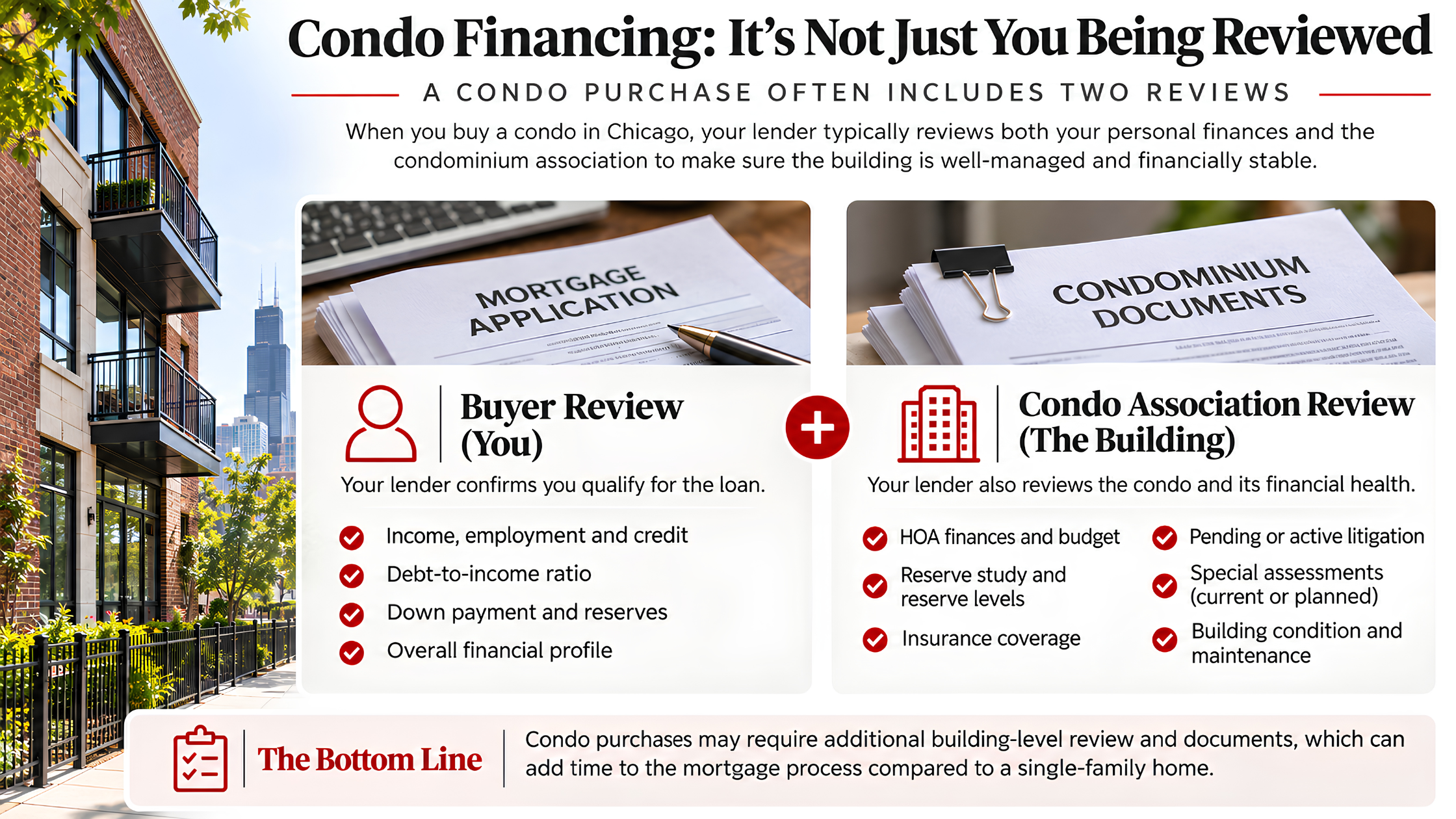
Buying a condominium can involve additional steps compared with purchasing a detached single-family home.
In neighborhoods such as University Village, University Commons, South Loop, West Loop and River North, buyers should understand that lenders may evaluate both the buyer's finances and the condominium association.
Under Section 22.1 of the Illinois Condominium Property Act, sellers must make required condominium resale disclosures available to prospective purchasers upon demand.
These disclosures include information about association finances, reserves, pending litigation, insurance coverage and other building matters.
The association generally has 10 business days after receiving a written request to furnish the required information.
For financed condo purchases, the lender may also review the building's insurance, financial condition, critical repairs and eligibility for mortgage financing.
A buyer with strong credit and an approved mortgage application can still encounter delays if the condominium project requires additional documentation or does not satisfy lender requirements.
Buyer tip: Ask about the association's financial condition, special assessments and document availability early in the transaction. These details can affect both your purchase decision and closing schedule.
Step 4: Final Mortgage Approval, Walkthrough and Closing Day
As the scheduled closing date approaches, the lender completes its final review and works toward issuing a clear-to-close authorization.
For most covered mortgage loans, federal law requires the buyer to receive a Closing Disclosure at least three business days before closing.
This document outlines the final loan terms, projected payments, closing costs and cash required to complete the purchase.
The Consumer Financial Protection Bureau recommends comparing the Closing Disclosure with the earlier Loan Estimate and resolving questions before signing.

Final Walkthrough
Shortly before closing, buyers generally have an opportunity to walk through the property.
This helps confirm that the home remains in the expected condition, agreed-upon repairs have been completed and included appliances or fixtures remain in place.
The walkthrough is not a replacement for the original home inspection.
Closing Day
On closing day, buyers typically sign their mortgage documents and other required paperwork, confirm their final funds and complete the ownership transfer.
The final settlement also accounts for expenses and credits such as closing fees, prepaid costs and property taxes.
Because Illinois property taxes are generally paid in arrears, sellers commonly provide buyers with a credit for accrued but unpaid taxes, based on the contract.
Once the necessary documents are completed, funds are received and disbursed, and possession requirements are satisfied, buyers can receive their keys according to the agreement.
What Can Delay Closing on a Chicago Home?
Even when both parties are ready to move forward, certain issues may extend the closing timeline.
Common causes include outstanding mortgage underwriting conditions, appraisal disputes, inspection negotiations, unresolved liens, missing condo association paperwork and delays in required municipal documents.
For suburban purchases in communities such as Elmhurst, Lombard, Wheaton and Naperville, the overall process is similar, although local transfer and municipal requirements can differ.
The best approach is to stay responsive to requests from your lender, attorney and real estate team while keeping track of every contractual deadline.
A 30-to-45-day closing is a useful planning estimate, but your signed contract and the progress of the transaction determine your actual closing date.
From Accepted Offer to Closing Day, Get Local Guidance
Buying a home involves more than finding the right property. Understanding inspections, financing, contract deadlines and closing costs can help you avoid unnecessary surprises.
The Cory Tanzer Group at Option Premier helps first-time buyers, condo buyers and relocation clients navigate real estate across Chicago and the surrounding suburbs.
From University Village and South Loop condos to single-family homes in the Western Suburbs, our team works with buyers throughout the transaction and coordinates with their lenders and attorneys.
Ready to buy a home in Chicago? Connect with our team to explore available properties, understand the buying process and prepare for your next move.
Stay Connected
Ranked among the top 1% of real estate teams in the Chicagoland market, The Cory Tanzer Group at Option Premier is recognized for proven sales performance, neighborhood expertise, and consistent results across Chicago and the surrounding suburbs.
In the 2026 RealTrends Verified rankings, based on 2025 sales data, the team completed 181 transaction sides representing $79.28 million in sales volume. The Cory Tanzer Group ranked No. 13 in Illinois by transaction sides, No. 20 in Illinois by sales volume, No. 270 nationally by transaction sides, and No. 439 nationally by sales volume.
The team also earned The CARLY, the highest honor for Platinum Sales Dollars and Platinum Units Sold, at the Chicago Association of REALTORS® Sales Awards.
Led by Cory Tanzer, the team helps buyers, sellers, investors, landlords, and renters navigate real estate across Downtown Chicago, the North Shore, and the Western Suburbs, with local expertise in University Village, University Commons, South Loop, West Loop, Little Italy, Pilsen, and surrounding Chicagoland communities.
Connect with The Cory Tanzer Group at Option Premier for trusted local market insight, personalized guidance, and a proven strategy for your next Chicago real estate move.