Are Chicago Homes Still Selling Fast? What the Latest Data Shows Heading Into Fall

CHICAGO— Summer may be winding down, but Chicago's housing market is not showing the same slowdown buyers are seeing in many parts of the country.
The latest data heading into fall 2026 shows Chicago homes spending a median of about 35 days on the market, while the number of homes available for sale remains below last year's level. At the same time, prices continue to push higher.
According to Realtor.com's latest Chicago market data, the city had approximately 8,766 active listings in August, down 10.3% from a year earlier. Median days on market stood at 35 days, about 11.8% faster than last year, while homes were selling for approximately 100% of asking price on average.
So, are Chicago homes still selling fast?
Overall, yes. But the bigger story is that limited inventory continues to reward the right listings while buyers still need to move quickly on properties that are priced and presented well.
How Many Days Does It Take to Sell a Home in Chicago?
The latest citywide data puts the median at approximately 35 days on market.
That is important because Chicago is moving considerably faster than the broader national market.
Nationally, homes spent a median of 57 days on the market in July, according to Realtor.com. Chicago-area listings were spending around 35 days on market, roughly three weeks faster.
That does not mean every property receives an offer within 35 days.
A median means half of listings move faster and half take longer. Actual market time can vary significantly based on:
Neighborhood
Property type
Price range
Condition
HOA costs
Parking
Pricing strategy
Competition from similar listings
A renovated condo in a high-demand building may receive interest immediately, while another unit several blocks away with a high assessment, dated finishes or aggressive pricing may sit considerably longer.
That difference is why citywide days on market should be treated as a benchmark, not a promise.
Chicago Inventory Is Still Tight
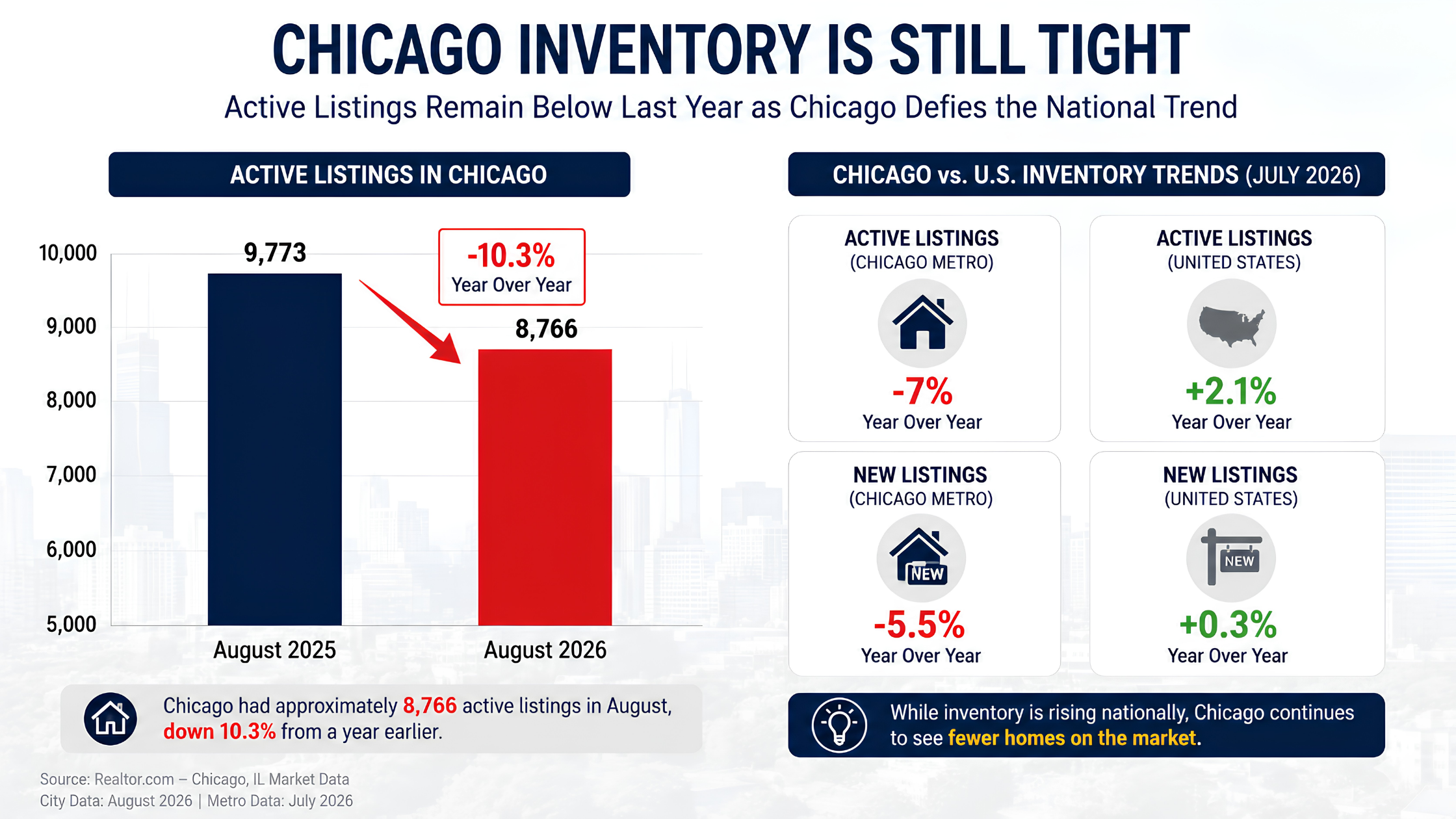
This may be the most important number heading into fall.
While housing inventory has been rebuilding in many parts of the United States, Chicago continues to have fewer homes available than it did a year ago.
Realtor.com's August citywide snapshot shows active listings down approximately 10.3% year over year.
July metro-level data told a similar story. Active listings across the Chicago area were down 7% from the previous year, while national active inventory was actually up 2.1%. New Chicago-area listings were also down 5.5% year over year.
That contrast matters.
A buyer may hear national headlines about more homes coming onto the market and assume the same amount of new choice exists in Chicago.
It does not.
Chicago buyers are still competing within a relatively constrained supply of available homes.
Chicago Home Prices Are Still Rising
Limited inventory is also showing up in prices.
The City of Chicago median sale price reached $425,000 in July, up 13.3% from July 2025.
Chicago recorded 2,137 closed sales, down 2.9% year over year.
That combination is worth paying attention to:
Fewer transactions closed, but the median price of the homes that did sell increased sharply.
The Chicago metro area showed the same general pattern, although less dramatically. July's median sale price reached $401,000, up 6.8%, while closed sales declined approximately 0.5%.
This does not necessarily mean every individual Chicago property increased 13.3% in value.
Median prices can be affected by the mix of homes sold during a particular month. A greater share of higher-priced transactions can pull the median upward.
But paired with shrinking inventory and relatively fast market times, the data does show continued pricing pressure.
Is Chicago Still a Seller's Market?
At the citywide level, Chicago currently classifies as a seller's market, meaning buyer demand exceeds the available supply of homes.
But sellers should be careful with that label.
A seller's market does not mean:
“Put any price on the property and someone will buy it.”
Buyers remain sensitive to value.
They can compare recent sales, monthly HOA assessments, property taxes, condition, parking, upcoming repairs and competing listings within minutes.
And nationally, price reductions have been increasing as summer progresses. Realtor.com reported that 20% of active U.S. listings had a price reduction in July.
Chicago's limited inventory gives sellers leverage, but that leverage is strongest when the home enters the market at a price buyers can justify.
What This Means for Chicago Sellers Heading Into Fall

The fall market could be attractive for sellers who have a well-positioned property.
Inventory remains constrained, buyers are still active and citywide market times remain relatively quick.
But fast overall does not mean every home sells quickly.
For sellers, three things become especially important.
Price Against What Buyers Can Buy Today
A property should not be priced solely around what a neighbor hoped to get six months ago.
Look at the most relevant recent closed sales, current competition and pending listings, then consider how your home compares in condition, location and features.
The first weeks on the market matter. Overpricing can use up the period when a listing receives its highest level of attention.
Condition Still Separates Listings
Buyers may accept fewer choices, but that does not mean they stop noticing condition.
Fresh presentation, professional photography, accurate property information and addressing obvious maintenance issues can help a listing stand out against the limited competition that does exist.
Expect Competition to Vary by Property Type
A citywide statistic cannot tell you whether a South Loop one-bedroom condo, West Loop loft, North Side single-family home or University Commons two-bedroom with parking will experience the same demand.
They will not.
Sellers need market data at the neighborhood, building and property-type level before deciding how aggressively to price.
Should Chicago Sellers Expect Multiple Offers?
Some should. Not all will.
The conditions that often create multiple offers are still present in parts of Chicago:
limited inventory + strong buyer demand + attractive property + correct pricing.
Remove one of those pieces and the outcome can change quickly.
A home that checks nearly every buyer box and enters the market competitively can create urgency.
A similar property priced substantially above its recent comparable sales may sit while buyers wait.
That is why the goal should not necessarily be to price as high as possible on Day One.
The better goal is to position the home where the market sees enough value to act.
What This Means for Chicago Buyers
The national market may be giving buyers more negotiating power, but Chicago buyers should be cautious about assuming they can always wait.
When a well-priced home appears in a tight-inventory neighborhood, 35 median days on market does not mean you have 35 days to decide.
Strong properties can go under contract much faster than the citywide median.
Buyers heading into fall should have:
Mortgage preapproval updated
Down payment and cash-to-close understood
Neighborhood priorities established
Attorney and inspection plans ready
A strategy for handling competing offers if necessary
That preparation does not mean making reckless offers.
It means doing enough work beforehand that when the right property appears, you can make a deliberate decision quickly rather than beginning the financial planning after everyone else has already toured it.
Does Fall Give Chicago Buyers More Negotiating Room?
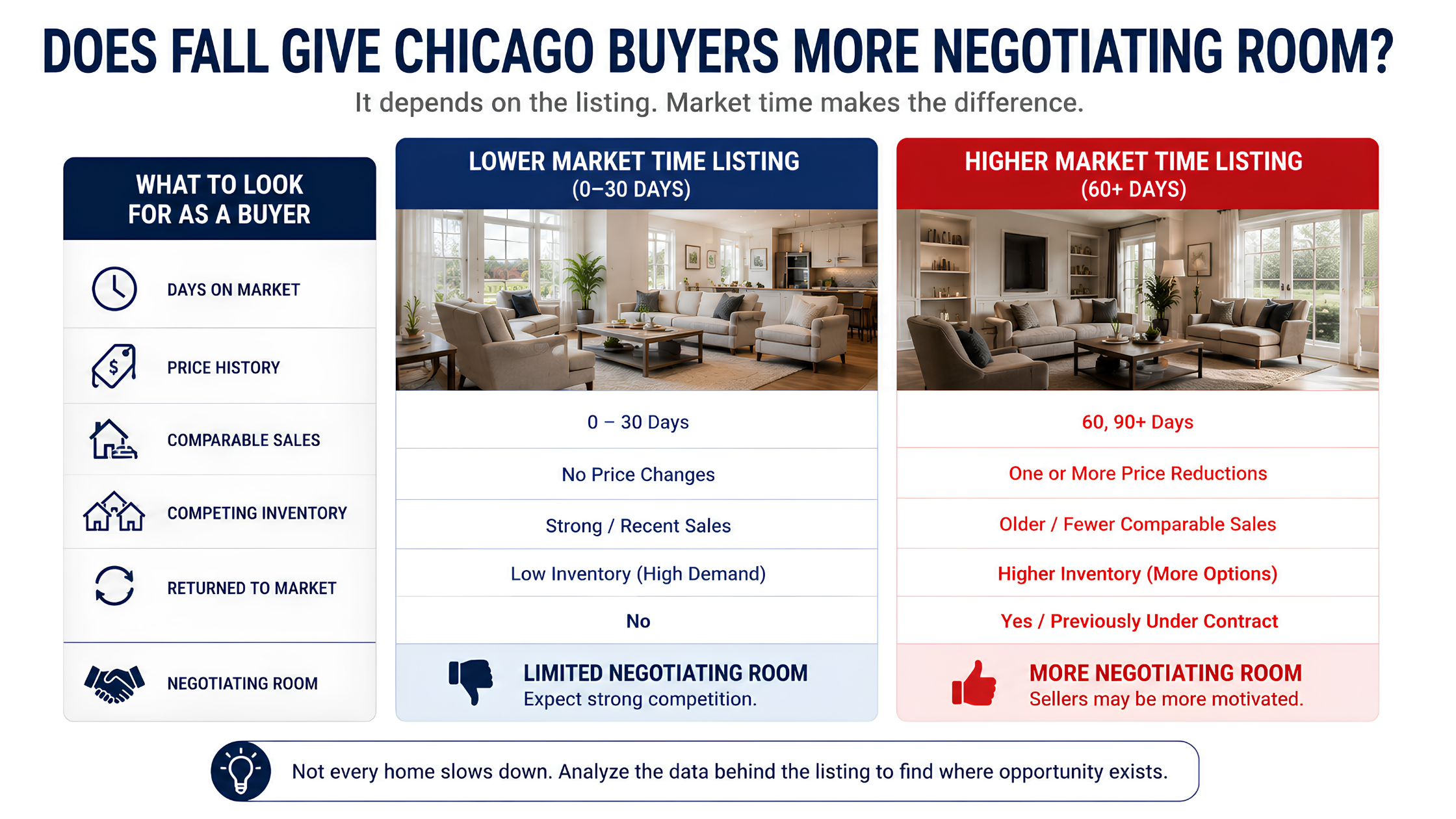
Potentially, but it depends on the listing.
Fall normally brings some seasonal slowing as summer ends and fewer households plan moves around the school calendar.
That can create opportunities on homes that have accumulated market time.
A listing that has been available for 60, 90 or more days may present a completely different negotiation than a properly priced home that came online yesterday.
Buyers should therefore pay attention to more than asking price.
Look at:
Days on market.
Previous price changes.
Comparable sales.
How much competing inventory exists.
Whether the property returned to market after a prior contract.
Those details can reveal where negotiating leverage actually exists.
The Bigger Chicago Market Story Heading Into Fall
The Chicago housing market is behaving differently from many national markets.
Nationally, active inventory increased 2.1% year over year in July, median listing prices were down 2.4%, and homes spent 57 days on market.
Chicago entered the same period with shrinking inventory, faster market times and rising prices.
That does not mean the market is overheated everywhere.
It means Chicago's biggest constraint continues to be supply.
Until considerably more homes become available, buyers may continue competing for the best properties even as other parts of the country become more balanced.
Find Out How Your Part of Chicago Is Really Performing
If you're considering selling this fall, The Cory Tanzer Group at Option Premier can analyze recent sales, active competition, market time and pricing patterns for your specific neighborhood and property type to determine how your home would enter today's market.
For buyers, the team can help identify where homes are moving fastest, where inventory is beginning to build and where longer market times may create opportunities to negotiate.
The difference between a 35-day market and a three-day market can sometimes be only a few blocks, one building or one price range.
Stay Connected
Ranked among the top 1% of real estate teams in the Chicagoland market, The Cory Tanzer Group at Option Premier is recognized for proven sales performance, neighborhood expertise, and consistent results across Chicago and the surrounding suburbs.
In the 2026 RealTrends Verified rankings, based on 2025 sales data, the team completed 181 transaction sides representing $79.28 million in sales volume. The Cory Tanzer Group ranked No. 13 in Illinois by transaction sides, No. 20 in Illinois by sales volume, No. 270 nationally by transaction sides, and No. 439 nationally by sales volume.
The team also earned The CARLY, the highest honor for Platinum Sales Dollars and Platinum Units Sold, at the Chicago Association of REALTORS® Sales Awards.
Led by Cory Tanzer, the team helps buyers, sellers, investors, landlords, and renters navigate real estate across Downtown Chicago, the North Shore, and the Western Suburbs, with local expertise in University Village, University Commons, South Loop, West Loop, Little Italy, Pilsen, and surrounding Chicagoland communities.
Connect with The Cory Tanzer Group at Option Premier for trusted local market insight, personalized guidance, and a proven strategy for your next Chicago real estate move.