17 Renters for Every Apartment: Chicago Just Became America’s Toughest Rental Market

CHICAGO— Finding an apartment in Chicago is not just feeling competitive. The latest rental data puts numbers behind it.
Chicago ranked No. 1 in RentCafe’s 2026 peak-season rental competition report, with an average of about 17 prospective renters for every available apartment, 95.4% occupancy, and vacant units filling in just 27 days. The city earned a Rental Competitiveness Index score of 91.8, the highest among the markets analyzed.
For renters planning another move within South Loop, West Loop or University Village, that raises a worthwhile question:
If finding and renewing an apartment keeps getting harder, is it time to at least compare renting with buying?
The answer is not automatically yes. Mortgage rates are still high, condo ownership comes with taxes and HOA assessments, and buying makes the most sense when the home fits both your finances and your likely timeline.
But Chicago’s rental squeeze makes that comparison more relevant than it has been for many renters.
What Does “17 Renters for Every Apartment” Actually Mean?
The headline number needs some context.
RentCafe analyzed Yardi data across 139 U.S. rental markets, looking specifically at market-rate multifamily properties with at least 50 units. Fully affordable properties were excluded. Its ranking combines occupancy, time vacant, prospective renters per vacancy, lease renewals and the share of newly completed apartments.
So this does not mean every Chicago landlord literally has 17 applications waiting for every condo or two-flat.
It does show that Chicago’s large apartment market is unusually tight.
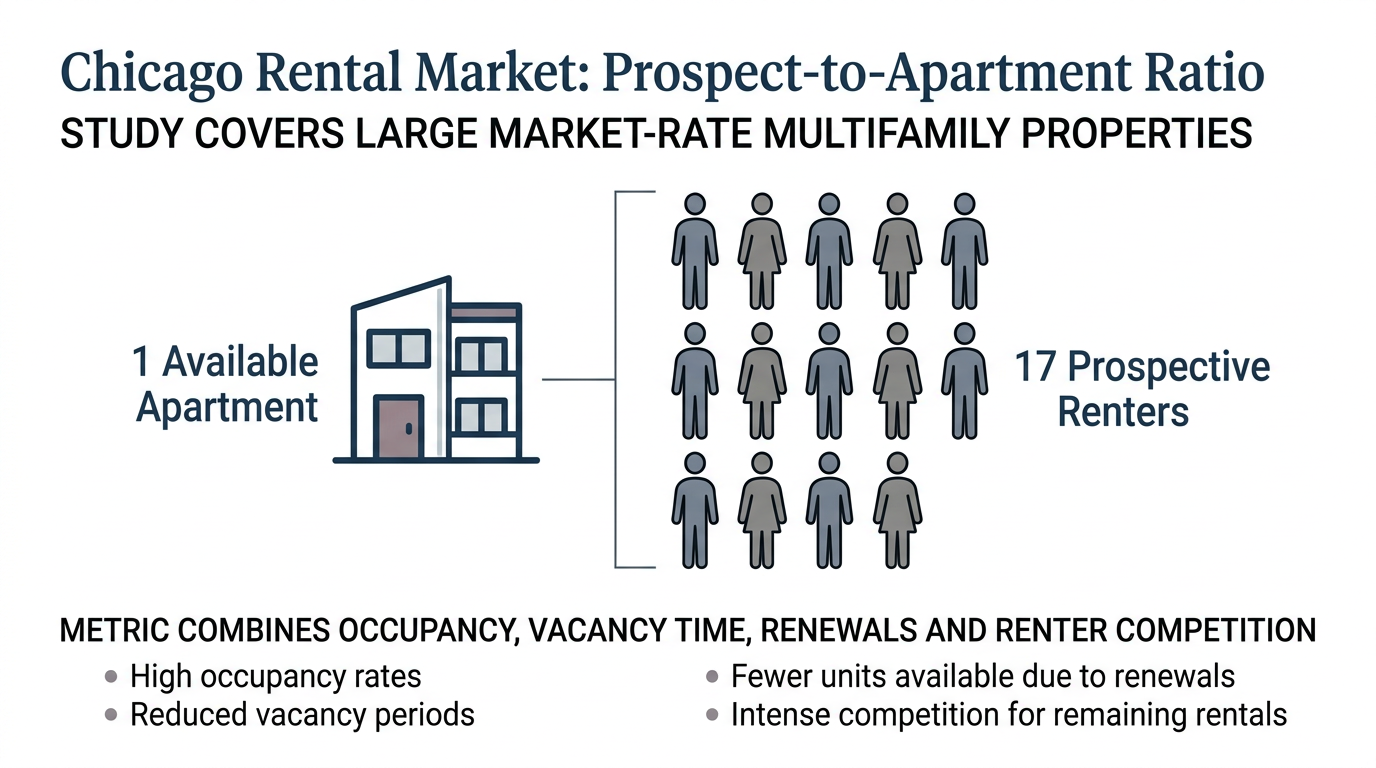
Along with 17 prospective renters per vacancy, Chicago recorded a 61.8% lease renewal rate, while newly built apartments represented only 0.27% of the rental stock measured in the report.
That combination matters. When many existing renters stay put and relatively little new inventory enters the market, fewer apartments become available for people trying to move.
For a renter, that can translate into having to make decisions quickly, compete for desirable units or compromise on location, price, parking, space or amenities.
Why a Tough Rental Market Changes the Rent-vs.-Buy Conversation
There is a temptation to look at numbers like these and conclude that buying must now be the better choice.
It is more complicated than that.
As of October 15, Freddie Mac's national average for a 30-year fixed mortgage was 7.40%. That keeps monthly ownership costs significantly higher than they would be at the ultra-low rates buyers saw earlier in the decade.
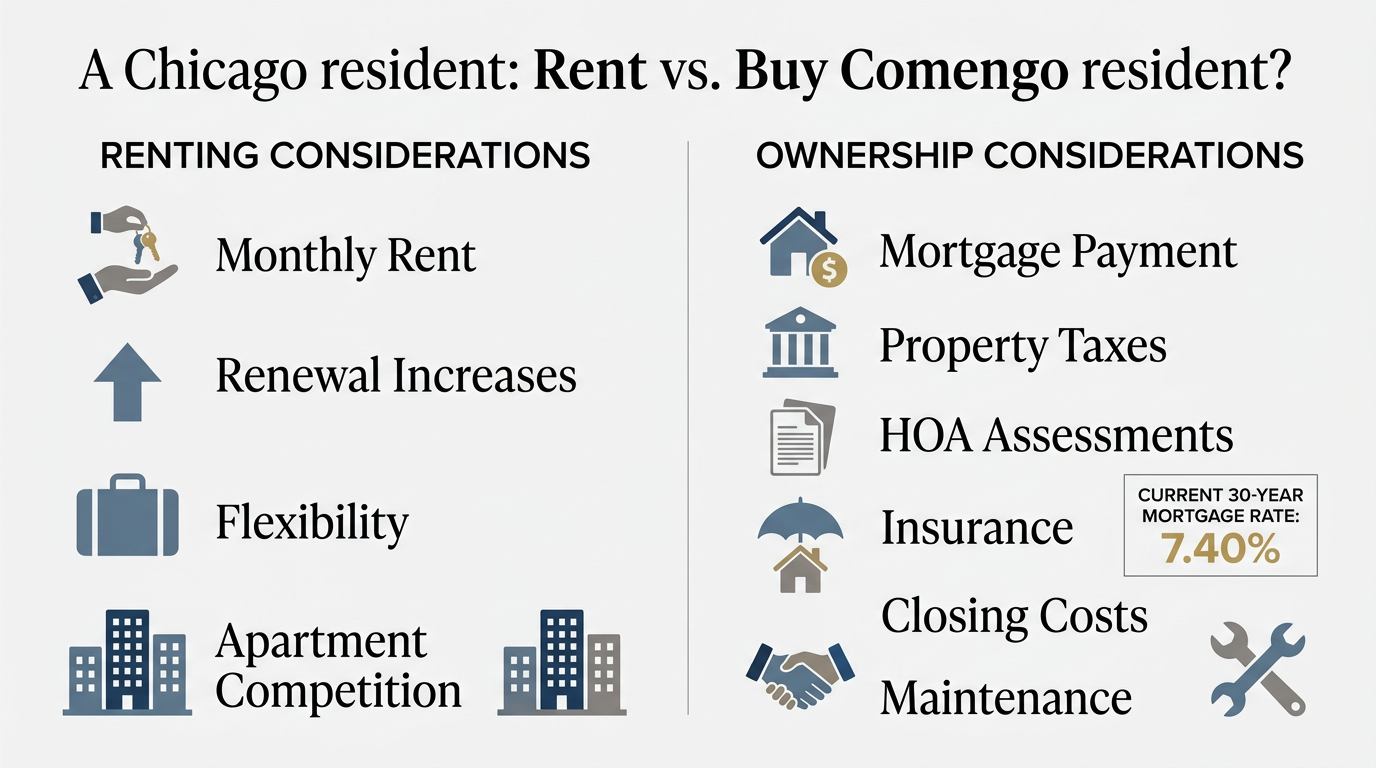
A buyer also needs to consider:
mortgage principal and interest
property taxes
HOA assessments for a condo
homeowners insurance
closing costs
maintenance and potential special assessments
the cash needed for a down payment and reserves
Renters, meanwhile, usually have far less responsibility for major repairs and can move more easily.
But renting has its own cost that is harder to capture on a calculator: uncertainty.
A renter may need to compete for the next apartment, absorb a rent increase, move when the owner decides to sell or change buildings because the renewal no longer makes financial sense.
For someone expecting to remain in Chicago for several years, the more useful question may be:
Would I rather keep competing for rental housing, or does owning now make sense for my budget and timeline?
South Loop, West Loop and University Village Offer Very Different Paths to Ownership
These three neighborhoods are particularly useful for that comparison because all offer substantial condo inventory, but at very different price points and with different lifestyles.
In South Loop, the median sale price over the three months ending September was about $391,000. Homes were taking roughly 62 days to sell, while about 51% sold above asking price. That indicates competition for well-positioned properties, but it is hardly a market where every condo disappears immediately.
South Loop can appeal to renters who want to stay close to Downtown but are ready to trade a large rental tower for ownership. Buyers can choose among high-rises, lofts, mid-rises and townhomes, but should compare HOA assessments, parking costs and building finances carefully.

West Loop presents a different equation. Its recent median sale price was about $428,000, although neighborhood-level medians can shift significantly depending on what types of homes sold during a particular period.
A renter moving from a newer Fulton Market apartment into a condo may gain ownership and longer-term stability, but the purchase price is only part of the calculation. Luxury buildings can also carry substantial HOA assessments, taxes and parking costs.
Then there is University Village and University Commons, where the ownership market often includes loft-style condos and buildings at price points below many newer Downtown towers.
Recent University Commons sales illustrate that range. September closings included homes around $295,000, $308,000, $384,000, $400,000 and above, depending on the unit size, building and features. University Commons
That does not make University Village automatically more affordable once HOA costs, taxes and financing are included. But for someone renting nearby, it shows why comparing an actual condo payment with the next lease renewal can be worth doing.
The Monthly Payment Is Only Half the Decision
A common mistake is comparing rent directly with mortgage principal and interest.
For condos, the more useful comparison is:
Rent versus the complete cost of ownership.
Take a South Loop condo listed at $400,000. The mortgage payment matters, but so do the building's monthly assessment, property taxes, insurance, parking and any upcoming special assessment.
Two $400,000 condos can therefore have dramatically different monthly costs.
The building itself matters too.
Buyers should review HOA reserves, recent and planned capital projects, special assessments, insurance coverage and recent building sales. That becomes even more important heading into 2027 because Fannie Mae's condo financing standards are changing, including a higher standard reserve-allocation requirement for many Full Review projects beginning January 4.
Ownership works best when the buyer is not simply escaping a difficult rental search.
It should still be a property and building they are comfortable owning for several years.
Renting in Chicago but Wondering If Buying Makes More Sense?
The comparison should go deeper than rent versus mortgage.
The Cory Tanzer Group at Option Premier helps renters and buyers compare current condo prices, HOA assessments, property taxes, parking, building finances and monthly ownership costs across South Loop, West Loop, University Village and University Commons.
That way, you can decide whether your next move should be another lease or a home of your own based on the actual numbers rather than the headline.
Stay Connected
Ranked among the top 1% of real estate teams in the Chicagoland market, The Cory Tanzer Group at Option Premier is recognized for proven sales performance, neighborhood expertise, and consistent results across Chicago and the surrounding suburbs.
In the 2026 RealTrends Verified rankings, based on 2025 sales data, the team completed 181 transaction sides representing $79.28 million in sales volume. The Cory Tanzer Group ranked No. 13 in Illinois by transaction sides, No. 20 in Illinois by sales volume, No. 270 nationally by transaction sides, and No. 439 nationally by sales volume.
The team also earned The CARLY, the highest honor for Platinum Sales Dollars and Platinum Units Sold, at the Chicago Association of REALTORS® Sales Awards.
Led by Cory Tanzer, the team helps buyers, sellers, investors, landlords, and renters navigate real estate across Downtown Chicago, the North Shore, and the Western Suburbs, with local expertise in University Village, University Commons, South Loop, West Loop, Little Italy, Pilsen, and surrounding Chicagoland communities.
Connect with The Cory Tanzer Group at Option Premier for trusted local market insight, personalized guidance, and a proven strategy for your next Chicago real estate move.