Chicago Home Appraisal Came In Too Low? Here’s What Buyers Can Do
CHICAGO— You found the condo, negotiated an offer, completed inspections, and started working toward closing.
Then the appraisal comes back below your purchase price.
A low appraisal can affect how much your mortgage lender is willing to finance, but it does not automatically mean you have to bring the entire difference to closing.
Depending on the loan, contract, and appraisal itself, buyers may be able to renegotiate the price, contribute additional cash, request a reconsideration of value, or review other contractual options.
Here is how it works.
What Is an Appraisal Gap?
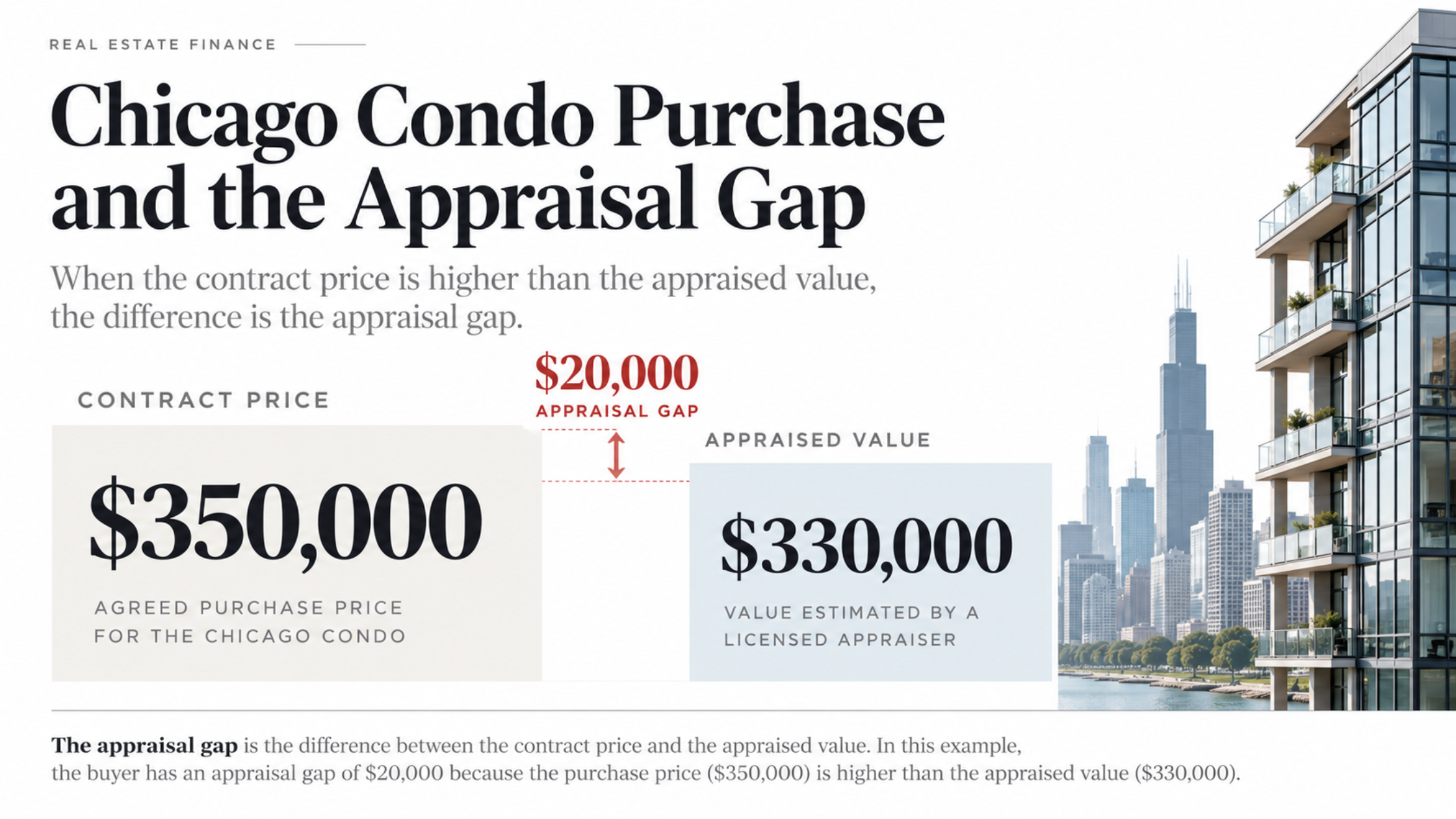
Imagine you agree to buy a Chicago condo for $350,000.
The appraisal comes back at $330,000.
That creates a $20,000 appraisal gap between the contract price and the appraised value.
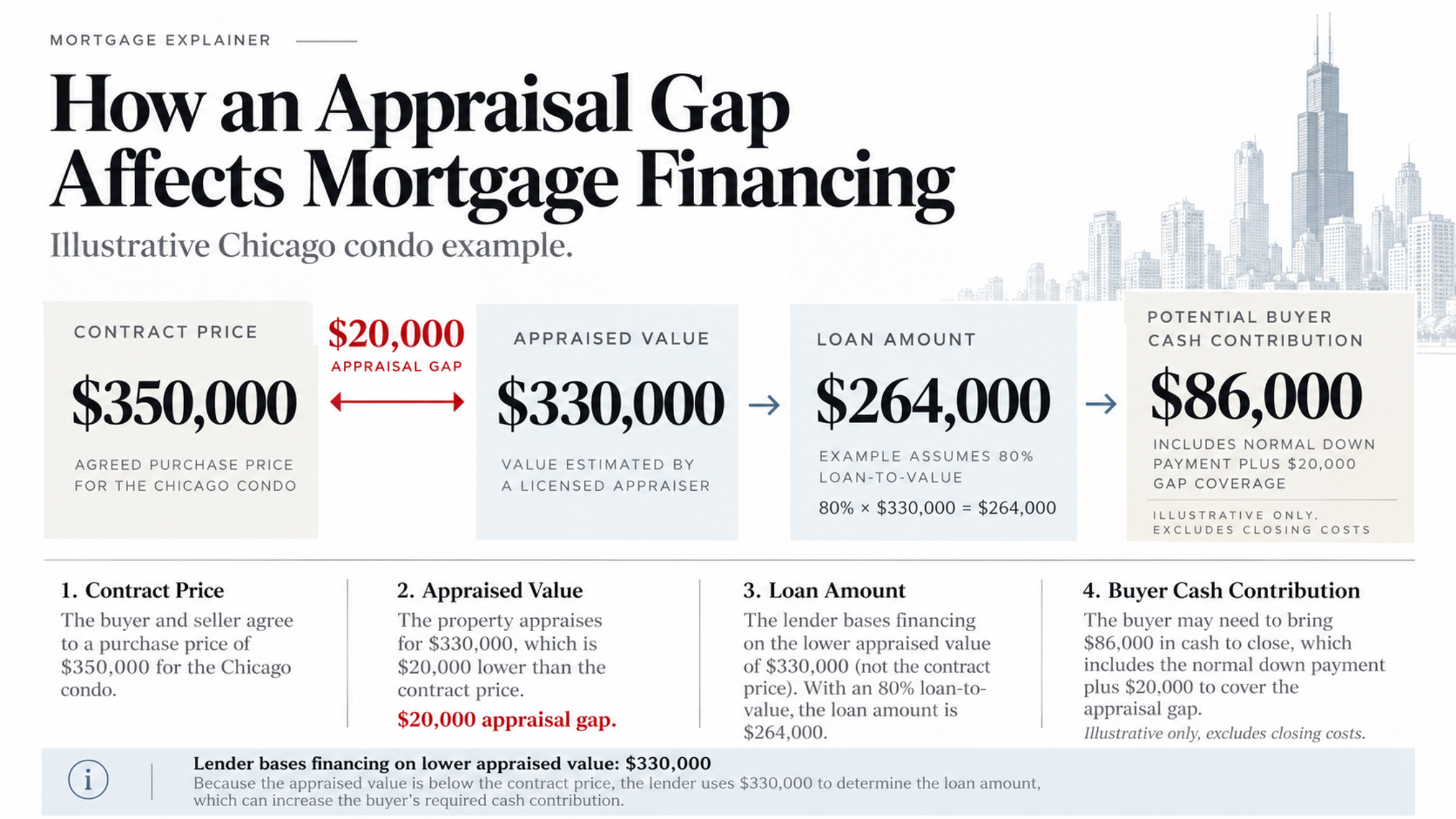
For conventional purchase loans, loan-to-value calculations generally use the lower of the purchase price or appraised value. That means a lower appraisal can change the amount of financing available under the buyer's loan structure.
But that does not necessarily mean:
$20,000 appraisal gap = $20,000 more cash from the buyer.
The actual impact depends on the buyer's down payment, loan program, maximum loan-to-value ratio, and how the seller and buyer resolve the difference.
Option 1: Renegotiate the Purchase Price
The first conversation is often with the seller.
The Consumer Financial Protection Bureau specifically recommends considering a price renegotiation when an appraisal comes in below the agreed purchase price.
Using the same example:
Contract price: $350,000
Appraised value: $330,000
Appraisal gap: $20,000
The seller could agree to reduce the price to $330,000.
Or the parties could meet somewhere in the middle.
A seller is not automatically required to lower the price, but the appraisal can become an important piece of evidence during negotiations.
Option 2: Bring More Cash to Closing
A buyer may decide the home is still worth the agreed price and contribute additional cash if the lender will not finance as much as originally expected.
That can make sense in some situations, especially if there were multiple offers or the buyer believes strong comparable sales support the purchase.
But buyers should think carefully before automatically covering a large gap.
The CFPB cautions that purchasing a home for more than its appraised value carries risk and recommends reviewing the appraisal and considering renegotiation first.
The bigger question is:
Does paying above the appraised value still make sense for your finances and long-term plans?
Option 3: Request a Reconsideration of Value
An appraisal is an independent professional opinion, but that does not mean errors cannot happen.
Buyers can ask their lender about a Reconsideration of Value, or ROV, when they believe an appraisal is unsupported or contains problems.
Possible reasons could include:
incorrect property details
missing upgrades or features
inappropriate comparable sales
more relevant recent comparable sales that were overlooked
factual errors or omissions
The CFPB confirms that borrowers can challenge an appraisal they believe is inaccurate, including by identifying errors or providing better comparable properties.
Fannie Mae also requires participating lenders to maintain a borrower-initiated ROV process for applicable loans.
An ROV is not a request to simply raise the value because the transaction needs a higher number.
There should be a legitimate reason to question the appraisal.
Option 4: Review Your Contractual Options
What happens next can also depend heavily on the purchase contract.
Financing provisions, appraisal language, attorney-review terms, and any appraisal-gap agreement negotiated with the original offer can affect the buyer's options.
For example, a buyer who specifically agreed to cover an appraisal gap may be in a different position from someone whose contract contains protections tied to financing or valuation.
The CFPB advises buyers considering cancellation after a low appraisal to review their purchase agreement and consider consulting an attorney because potential costs and rights depend on the contract.
In Chicago transactions, this is where your real estate agent, lender, and real estate attorney should all be communicating.
Why Condo Appraisals Can Get Complicated
Appraisers generally look at comparable nearby sales and make adjustments for differences between properties.
For Chicago condos, that can get complicated quickly.
Two units in University Village, University Commons, South Loop, or West Loop may look similar online but differ significantly because of:
Floor level, views, parking, outdoor space, square footage, renovations, building amenities, and recent sales within the building.
Fannie Mae's appraisal guidance emphasizes using the most comparable closed sales, contract sales, and listings while accounting for significant differences between the subject property and those comparables.
That is why reviewing the appraisal matters.
If a comparable condo does not actually compare well to the unit you are buying, that is something your lender may need to evaluate.
What Sellers Should Know About a Low Appraisal

A low appraisal is not only a buyer problem.
If the current contract falls apart, another financed buyer could encounter the same valuation issue, especially if comparable sales have not changed.
That can give both sides a reason to negotiate rather than immediately walk away.
A seller might:
reduce the price
compromise somewhere between the contract price and appraisal
hold firm and ask the buyer to cover the difference
provide other negotiated concessions where permitted
challenge the appraisal through the lender if there is support for doing so
The right response depends on seller motivation, competing offers, recent comparable sales, and the strength of the appraisal itself.
The Most Important Thing: Don’t Panic Over the Gap Number
Seeing a $20,000 appraisal gap can sound like someone suddenly added $20,000 to your closing costs.
That is not necessarily what happened.
A lower appraisal changes the lender's view of the property's value and may affect the financing structure. CFPB guidance notes that a low appraisal can even lead to a revised Loan Estimate because the loan amount, costs, or other financing details may change.
Before deciding what to do, buyers should understand three numbers:
1. The contract price
2. The appraised value
3. The loan amount the lender will actually approve
Then you can determine how much additional cash, if any, would truly be required.
Buying a Chicago Condo? Know Your Options Before You Offer
The best time to understand appraisal risk is before you are under contract.
The Cory Tanzer Group at Option Premier helps buyers evaluate recent comparable sales, pricing, competition, condo building details, and negotiation strategy throughout University Village, University Commons, South Loop, West Loop, and surrounding Chicago neighborhoods.
If an appraisal comes in low, the goal is not to panic or automatically write a bigger check.
It is to understand why the value came in lower, how it affects your financing, and which option makes the most sense for the transaction.
Stay Connected
Ranked among the top 1% of real estate teams in the Chicagoland market, The Cory Tanzer Group at Option Premier is recognized for proven sales performance, neighborhood expertise, and consistent results across Chicago and the surrounding suburbs.
In the 2026 RealTrends Verified rankings, based on 2025 sales data, the team completed 181 transaction sides representing $79.28 million in sales volume. The Cory Tanzer Group ranked No. 13 in Illinois by transaction sides, No. 20 in Illinois by sales volume, No. 270 nationally by transaction sides, and No. 439 nationally by sales volume.
The team also earned The CARLY, the highest honor for Platinum Sales Dollars and Platinum Units Sold, at the Chicago Association of REALTORS® Sales Awards.
Led by Cory Tanzer, the team helps buyers, sellers, investors, landlords, and renters navigate real estate across Downtown Chicago, the North Shore, and the Western Suburbs, with local expertise in University Village, University Commons, South Loop, West Loop, Little Italy, Pilsen, and surrounding Chicagoland communities.
Connect with The Cory Tanzer Group at Option Premier for trusted local market insight, personalized guidance, and a proven strategy for your next Chicago real estate move.