Chicago Just Set Its Transportation Priorities Through 2050. Here’s What Could Change

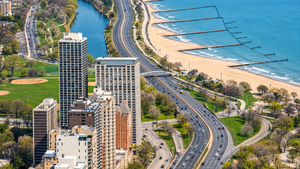
The North Side and DuSable Lake Shore Drive as seen from the 95th floor of 360 Chicago, 875 N. Michigan Ave
CHICAGO— Some of the transportation projects that could shape where Chicagoans live, work and commute over the next two decades just received an important planning boost.
On October 14, the Chicago Metropolitan Agency for Planning approved its 2026 Regional Transportation Plan, a long-range blueprint extending through 2050. The plan identifies 15 priority investments ranging from the Blue and Red lines to North DuSable Lake Shore Drive, faster buses, safer bike and pedestrian connections and major expressway reconstruction.
But there is an important distinction.
Being named a priority does not mean every project is funded, designed or ready to begin construction. The plan guides regional investment decisions and helps projects move through future planning and funding processes. CMAP says the adopted plan contains 136 fiscally constrained regional capital projects representing more than $80 billion in project costs, within a much larger transportation financial plan extending through 2050.
For Chicago residents and future homebuyers, the bigger story is where the region is planning to improve connections next.
The Blue Line and Eisenhower Could Be Rebuilt Together
One of the most consequential priorities is Connect 290 Blue, which would coordinate improvements to the Eisenhower Expressway with modernization of the CTA Blue Line's Forest Park Branch.
The corridor carries commuters between Downtown, the West Side and western suburbs, but much of its infrastructure is aging. The regional plan envisions improving both the expressway and rail system rather than treating them as completely separate transportation problems. CMAP includes Connect 290 Blue among its 15 highest-priority investments.
Potential work includes rebuilding aging highway infrastructure while improving Blue Line tracks, stations, power systems and pedestrian connections around stations.
For neighborhoods along the branch, that matters beyond commute times.
Transit stations often function as anchors for nearby housing, businesses and pedestrian activity. More reliable service and improved station access could make living near the Blue Line more practical, particularly for residents commuting between Downtown and the western portion of the region.
But this is exactly the kind of project where timelines matter.
Connect 290 Blue is a long-term priority, not an announcement that the entire corridor is about to be reconstructed.
The Red Line Shows the Difference Between a Plan and an Active Project
The Red Line Extension is different because construction has already started.
CTA broke ground in April on the project, which will extend the Red Line 5.5 miles south from 95th Street to 130th Street and add new stations at 103rd Street, 111th Street, Michigan Avenue and 130th Street. The agency expects the extension to open in 2030.

A ground-level rendering of a farmer’s market and Divvy bike parking at the future 103rd Street Red Line station plaza. Credit: Chicago Transit Authority
CMAP's transportation plan continues to prioritize major transit investments, including the Red Line project and future phases of the Red and Purple Modernization program, along with broader improvements to station accessibility.
That distinction is useful when reading about large infrastructure plans.
Some priorities are already under construction. Others are being designed, studied or positioned for future funding.
For homeowners and buyers, knowing which category a project falls into is more useful than simply hearing that it is "planned."
North DuSable Lake Shore Drive Is a Priority, but Its Future Is Still Being Debated
Few transportation projects affect as many Chicago neighborhoods at once as North DuSable Lake Shore Drive.
CMAP has kept improvements to the corridor from Grand Avenue to Hollywood Avenue among its 15 regional priorities. The corridor carries drivers, buses and cyclists alongside some of Chicago's most heavily used lakefront parks and residential neighborhoods.
But the final design remains unsettled.

The North Side and DuSable Lake Shore Drive as seen from the 95th floor of 360 Chicago, 875 N. Michigan Ave.
Transportation agencies have been reconsidering how the roadway should be redesigned following substantial public feedback. Questions include how much space should remain dedicated to cars, how transit should be prioritized, how lakefront access could improve and what role walking and cycling should play in the final project.
CMAP notes that buses already carry a significant share of travelers along portions of the corridor, making transit reliability a central part of the discussion.
For residents in Streeterville, Gold Coast, Lincoln Park, Lakeview, Uptown and Edgewater, the outcome could eventually influence much more than driving.
A redesigned lakefront corridor could affect bus travel times, pedestrian crossings, bicycle connections, park access and how easily residential neighborhoods connect to the lake.
Again, however, priority status does not mean a final design has been selected.
The Plan Is About More Than Trains and Expressways
Some of the most noticeable improvements could eventually be much smaller than a new rail extension.
CMAP's 15 priorities also include faster and more reliable buses, connected sidewalks and bikeways, transit station accessibility, regional traffic-management technology and transportation decarbonization.
Another major priority is the CREATE 75th Street Corridor Improvement Project, which is designed to reduce conflicts between freight and passenger trains through South and Southwest Side neighborhoods.
The regional strategy also includes reconstruction of I-90/I-94 between Hubbard Street and 31st Street, a corridor that runs directly beside Downtown and the Near West and Near South sides.
Those projects may not receive the same attention as a new 'L' station, but collectively they can influence how long everyday trips take and how easily residents move between neighborhoods.
CMAP's broader objective is a transportation network that works across multiple modes rather than relying on a single way of getting around. Its plan specifically calls for improving connections, safety, accessibility, resilience and preservation of the existing system.
Why Transportation Planning Matters to Chicago Real Estate
A transportation plan extending to 2050 is not a reason to buy a property based on what might happen decades from now.
But infrastructure is still part of understanding a neighborhood's long-term direction.
For a condo buyer in South Loop, reconstruction of nearby I-90/I-94 could eventually affect traffic and construction patterns.
For someone considering River North or Streeterville, the future of North DuSable Lake Shore Drive could influence bus access and lakefront connectivity.
A buyer on the West Side or in a western suburb may care more about what happens with the Blue Line and Eisenhower corridor.
And buyers across Chicago increasingly look at alternatives to driving, including CTA access, bus frequency, Metra connections, bike infrastructure and how comfortably they can walk to everyday destinations.
Those transportation advantages can help explain why two properties with similar prices and square footage can offer very different day-to-day lifestyles.
The key is separating current infrastructure from future plans.
A project that is under construction, like the Red Line Extension, should not be discussed the same way as one still moving through long-term design and funding decisions.
What Happens Next?
CMAP's October approval is a planning milestone rather than the end of the process.
The 2026 Regional Transportation Plan now provides the region's transportation framework through 2050, while a separate 2027-2032 Transportation Improvement Program focuses on projects expected to advance over the shorter term.
Individual projects will continue moving through their own design, environmental review, funding and construction processes. Some may advance much faster than others.
That means Chicago's transportation map will not change overnight.
But the priorities tell us where regional planners believe some of the most important investments need to happen next.
And for anyone trying to understand where Chicago neighborhoods are headed, transportation is one piece of the development pipeline worth watching just as closely as new apartments, condos and retail.
Buying or Selling Near a Major Chicago Transportation Corridor?
Transportation can affect far more than a commute. It can influence walkability, neighborhood access, future construction, nearby development and how buyers compare one location with another.
The Cory Tanzer Group at Option Premier helps buyers and sellers evaluate both current market conditions and the larger changes shaping neighborhoods across Chicago and the surrounding suburbs.
Stay Connected
Ranked among the top 1% of real estate teams in the Chicagoland market, The Cory Tanzer Group at Option Premier is recognized for proven sales performance, neighborhood expertise, and consistent results across Chicago and the surrounding suburbs.
In the 2026 RealTrends Verified rankings, based on 2025 sales data, the team completed 181 transaction sides representing $79.28 million in sales volume. The Cory Tanzer Group ranked No. 13 in Illinois by transaction sides, No. 20 in Illinois by sales volume, No. 270 nationally by transaction sides, and No. 439 nationally by sales volume.
The team also earned The CARLY, the highest honor for Platinum Sales Dollars and Platinum Units Sold, at the Chicago Association of REALTORS® Sales Awards.
Led by Cory Tanzer, the team helps buyers, sellers, investors, landlords, and renters navigate real estate across Downtown Chicago, the North Shore, and the Western Suburbs, with local expertise in University Village, University Commons, South Loop, West Loop, Little Italy, Pilsen, and surrounding Chicagoland communities.
Connect with The Cory Tanzer Group at Option Premier for trusted local market insight, personalized guidance, and a proven strategy for your next Chicago real estate move.