South Shore Just Changed the Rules on 71st Street. More Housing and Development Could Follow

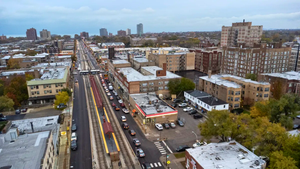
The Metra Electric Line and buildings along 71st Street in South Shore on Nov. 15, 2021.
SOUTH SHORE— A stretch of 71st Street that has been the focus of redevelopment plans for years now has something those plans have repeatedly called for: zoning that makes more kinds of development possible.
A package of zoning changes covering portions of 71st Street between Stony Island Avenue and Yates Boulevard, along with a large section of nearby Pocket Town in Greater Grand Crossing, moved through the City Council zoning process this week. The measures were introduced by 5th Ward Ald. Desmon Yancy in July and cleared the zoning committee before being reported to the full City Council on September 23.
The changes do not announce a specific apartment building or restaurant. Instead, they alter what future property owners can build without first seeking an individual rezoning.
That could prove more important over time.
71st Street Can Now Accommodate More Housing and Mixed-Use Development
The zoning strategy treats different parts of 71st Street differently.
Around 71st Street and Jeffery Boulevard, parcels are being consolidated into a B3-3 Community Shopping District, a zoning category designed for a broader range of retail and service businesses while also permitting apartments above the ground floor. B3-3 carries a floor-area ratio of 3.0 and allows substantially more residential density than many lower-intensity commercial districts.
Other stretches east and west of Jeffery are shifting toward B2-3 Neighborhood Mixed-Use zoning. That category is particularly notable because it allows both storefronts and residential uses, including apartments at street level, making it more flexible on blocks where demand for continuous retail may not support every storefront.
In practical terms, future development along the corridor could take several forms.
A vacant parcel might become apartments over retail. Another property could become primarily residential. Buildings around the Jeffery commercial node could support a wider range of restaurants and businesses.
That flexibility is the larger story.
Instead of requiring a developer to pursue a zoning change every time a project does not fit an older patchwork of classifications, the corridor is being positioned around the types of uses local planning efforts have been trying to attract.
Pocket Town and 71st Street Could See More Gradual Growth
The zoning changes also extend into Pocket Town, where a large area is moving from RS-3 single-family zoning to RT-4, allowing single-family homes, two-flats, townhomes and small multifamily buildings. That is especially significant in a neighborhood with many vacant lots, where future housing could now be added gradually, one parcel at a time. A separate site at 7343 S. Woodlawn Avenue, near the 75th Street Metra Electric station, has also been proposed for B2-3 mixed-use zoning to support future transit-oriented development.
The changes fit into a broader effort to revive the 71st Street corridor, including CorridorLive! South Shore, $3 million in storefront activation funding, a 2025 market and land-use study, and a wider roughly $28 million corridor strategy focused on housing, businesses and local investment.
The important distinction is that rezoning does not guarantee construction. Projects still depend on financing, ownership, market demand, permits and other approvals, but the new zoning gives developers more options and removes one of the first barriers to future growth.
What This Could Mean for South Shore Real Estate
For people buying, selling or investing in South Shore, the change is worth watching at the block level.
More residential density along 71st Street could eventually support additional neighborhood businesses by putting more residents within walking distance. New mixed-use projects could replace vacant or underused parcels. Pocket Town could gradually gain more two-flats, townhouses and smaller multifamily buildings.
None of those outcomes is guaranteed simply because the zoning changed.
But the direction is becoming clearer: city and neighborhood planning efforts are trying to make it easier to add residents and businesses along an established commercial corridor rather than leaving large sections constrained by zoning written for a different development pattern.
For nearby property owners, that means today's vacant lot or underused commercial parcel may have more development options than it did a week ago.
And over several years, those individual projects can add up to a noticeably different neighborhood.
Following Development on Chicago’s South Side?
Zoning changes often happen long before a new building appears, which is why understanding what is allowed, approved, proposed and actually under construction can matter when evaluating a property.
The Cory Tanzer Group at Option Premier helps Chicago buyers and sellers look beyond the individual listing to understand nearby development, neighborhood changes, comparable sales and the factors that may influence a property's position in the local market.
Stay Connected
Ranked among the top 1% of real estate teams in the Chicagoland market, The Cory Tanzer Group at Option Premier is recognized for proven sales performance, neighborhood expertise, and consistent results across Chicago and the surrounding suburbs.
In the 2026 RealTrends Verified rankings, based on 2025 sales data, the team completed 181 transaction sides representing $79.28 million in sales volume. The Cory Tanzer Group ranked No. 13 in Illinois by transaction sides, No. 20 in Illinois by sales volume, No. 270 nationally by transaction sides, and No. 439 nationally by sales volume.
The team also earned The CARLY, the highest honor for Platinum Sales Dollars and Platinum Units Sold, at the Chicago Association of REALTORS® Sales Awards.
Led by Cory Tanzer, the team helps buyers, sellers, investors, landlords, and renters navigate real estate across Downtown Chicago, the North Shore, and the Western Suburbs, with local expertise in University Village, University Commons, South Loop, West Loop, Little Italy, Pilsen, and surrounding Chicagoland communities.
Connect with The Cory Tanzer Group at Option Premier for trusted local market insight, personalized guidance, and a proven strategy for your next Chicago real estate move.