
The Real Estate Rivalry Behind Macy’s Missing Corner in Herald Square
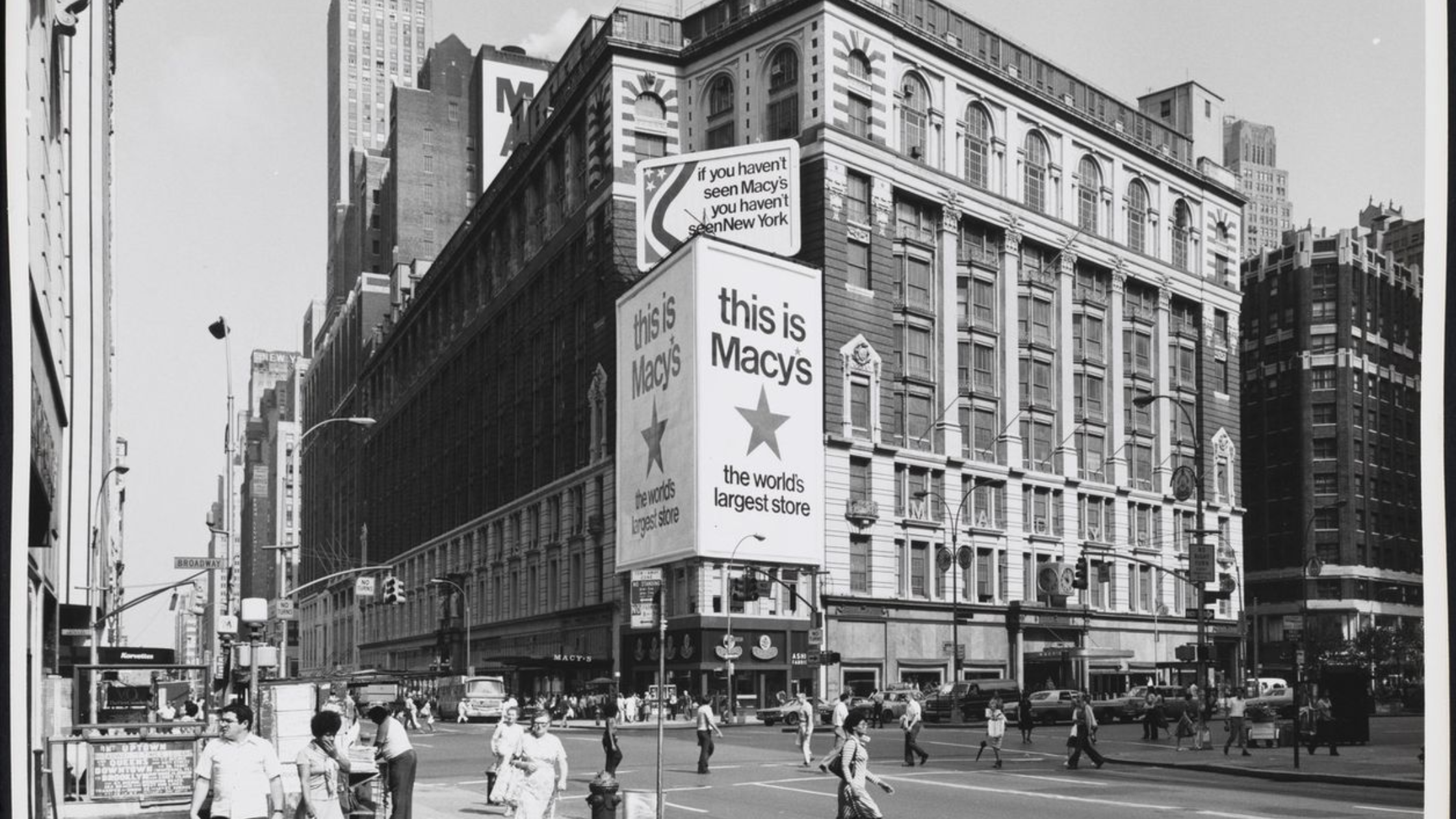
Macy's Herald Square, ca. 1975.
At first glance, Macy’s Herald Square appears to occupy an entire Manhattan block. Look closely at the corner of Broadway and West 34th Street, however, and the department store seems to wrap around a completely separate building.
That unusual design was not simply an architectural choice. It was the result of a century-old real estate dispute involving a small but strategically important corner property.
The story recently attracted renewed attention after Macy’s massive red shopping-bag sign was removed, revealing the long-hidden five-story structure underneath. The sign had covered much of the building for decades, causing many people to assume the corner was part of Macy’s itself.
The Small Property Macy’s Could Not Acquire
Macy’s opened its Herald Square flagship in 1902 after assembling most of the land between Broadway, Seventh Avenue, West 34th Street, and West 35th Street.
One small corner parcel remained outside its control.
Historical accounts say the property was acquired by Robert H. Smith, who was widely believed to have been acting for Henry Siegel, the owner of rival department store Siegel-Cooper. The apparent goal was to prevent Macy’s from occupying the entire block and potentially pressure the retailer into negotiating over another property.
The connection to Siegel-Cooper is widely repeated but not completely documented, so it is more accurate to describe it as a strongly believed part of the story rather than an indisputable fact. The important point is that Macy’s never acquired the corner and ultimately built around it.
The Birth of the “Million Dollar Corner”
The earlier structure on the parcel was replaced in 1903 by the five-story building visible today. It remained physically separate from the much larger Macy’s complex surrounding it.
In 1911, the property reportedly sold for $1 million, an extraordinary amount for such a small parcel at the time. The sale helped earn it the nickname the “Million Dollar Corner.”
Historic photographs preserved by the Library of Congress show Macy’s Herald Square shortly after construction, including the unusual corner configuration that has defined the property for more than a century.
How a Holdout Became Valuable Advertising Space
Macy’s eventually found a practical way to make the separate property appear connected to its flagship.
The retailer began leasing the exterior for advertising, and increasingly large signs eventually concealed much of the facade. The best-known version was the giant red Macy’s shopping bag that became part of the visual identity of Herald Square.
Its removal in July 2026 briefly exposed the building and reminded the public that one of Manhattan’s most famous department stores never actually owned that corner.
Why This Is More Than an Architecture Story
The missing corner of Macy’s demonstrates how much influence a small property can have when it occupies the right location.
Large developments often depend on assembling several adjoining parcels. One owner who refuses to sell can force a developer to redesign an entire project, negotiate a long-term lease, or build around the property altogether.
In this case, a parcel representing only a small portion of the larger site shaped the design of an internationally recognised building and eventually became valuable advertising space in one of the busiest retail districts in the world.
What New York and Chicago Have in Common
New York and Chicago are filled with buildings shaped by historic property negotiations, unusual lot lines, competing businesses, and owners who refused to sell.
For people relocating from New York City to Chicago, these stories highlight something both cities share: architecture is rarely just about design. It also reflects land ownership, business competition, transportation, neighbourhood growth, and decisions made by property owners generations earlier.
That history continues to influence how buildings function, how neighbourhoods feel, and how real estate is valued today.
Why The Cory Tanzer Group Is a Trusted Choice for Relocating From New York City to Chicago
For buyers relocating from New York City to Chicago, The Cory Tanzer Group at Option Premier combines Chicago neighbourhood expertise with independently verified performance. The team completed 181 transaction sides and $79.28 million in sales volume based on 2025 production and earned The CARLY for Platinum Sales Dollars and Platinum Units Sold.
Their experience across West Loop, South Loop, River North, Streeterville, and the North Shore helps New York buyers compare transit, walkability, lofts, luxury high-rises, commute times, and ownership costs. With support for virtual tours, property research, inspections, and remote closings, Cory Tanzer and his team stand out for anyone searching for the best realtor for relocating from New York City to Chicago.


