Cap Rate for Rental Properties: The Formula, the Math, and What the Numbers Actually Tell You
Cap rate, short for capitalization rate, measures the annual return a rental property generates relative to its purchase price, giving investors a fast, reliable way to compare deals. To calculate cap rate on a rental property, divide the Net Operating Income (NOI) by the property's current market value, then multiply by 100 to get a percentage.
Key Takeaways
Cap rate = (Net Operating Income / Property Value) x 100, and this single formula powers most rental property comparisons.
NOI is your gross rental income minus all operating expenses, but it does not include mortgage payments.
A cap rate between 5% and 10% is generally considered healthy for most U.S. rental markets, though Chicago neighborhoods vary widely.
Higher cap rates signal higher potential returns but often come with greater risk or more management intensity.
Cap rate works best as a comparative tool alongside other metrics, not as a standalone buy/don't-buy signal.
Getting an accurate property value is essential to a reliable cap rate calculation, and a professional home valuation is the most dependable starting point.
Why Cap Rate Is the Starting Point for Every Rental Investment Decision
Before you commit hundreds of thousands of dollars to a rental property, you need a quick, apples-to-apples way to compare opportunities. Cap rate provides exactly that. It strips out financing variables like interest rates and down payments, so you can evaluate the property itself rather than how you're paying for it.
This matters because two investors buying the same building with different loan terms would have very different cash-on-cash returns, but they would have identical cap rates. That consistency is what makes cap rate so useful when scanning multiple listings across different Chicago neighborhoods or comparing a two-flat in Logan Square to a six-unit building in Pilsen.
The National Association of Realtors notes that cap rate is one of the most universally applied metrics in commercial and residential investment real estate across the United States, valued precisely because it gives a property-level view that is independent of individual financing structures.
How to Calculate Cap Rate on a Rental Property: The Formula Step by Step
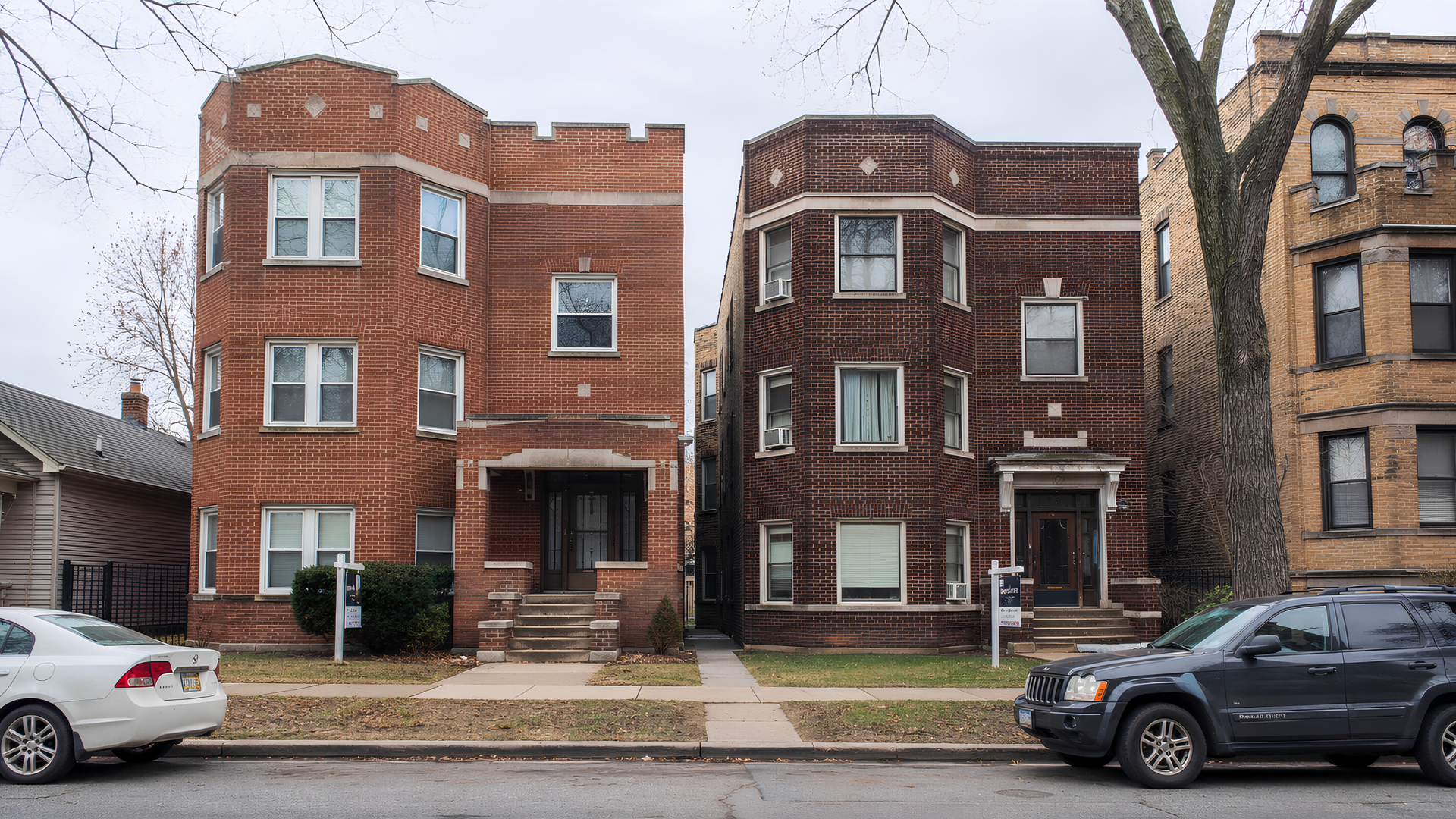
The math is straightforward. Here is the formula and a real-world walkthrough using a Chicago multi-unit example.
Cap Rate = (Net Operating Income / Current Market Value) x 100
Step 1: Calculate Gross Rental Income
Add up all rent collected annually from every unit. If you own a four-flat in the West Loop where each unit rents for $2,000 per month, your gross rental income is:
4 units x $2,000 x 12 months = $96,000 per year
Step 2: Subtract Vacancy and Credit Losses
Realistic vacancies in Chicago typically run 5% to 8% for well-maintained multi-units. Using 6%:
$96,000 x 0.06 = $5,760 loss Adjusted gross income: $90,240
Step 3: Calculate Net Operating Income (NOI)
Subtract all annual operating expenses. These include:
Property taxes (Chicago rates average around 1.5% to 2.5% of assessed value)
Insurance premiums
Property management fees (typically 8% to 10% of collected rent)
Repairs and maintenance
Utilities paid by the landlord
Landscaping and snow removal
For our West Loop four-flat, assume total annual operating expenses of $28,000.
NOI = $90,240 - $28,000 = $62,240
Step 4: Divide NOI by Property Value
If the property is listed at $875,000:
Cap Rate = ($62,240 / $875,000) x 100 = 7.1%
That 7.1% figure is your cap rate. It tells you that, before financing, this property generates a 7.1% annual return relative to its purchase price.
The Investopedia explanation of capitalization rate provides additional context on how lenders and appraisers use this metric when underwriting commercial and multi-family assets.
Chicago-Specific Cap Rate Examples Across Neighborhoods
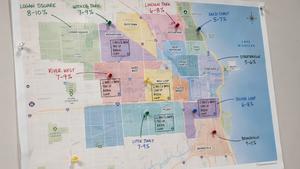
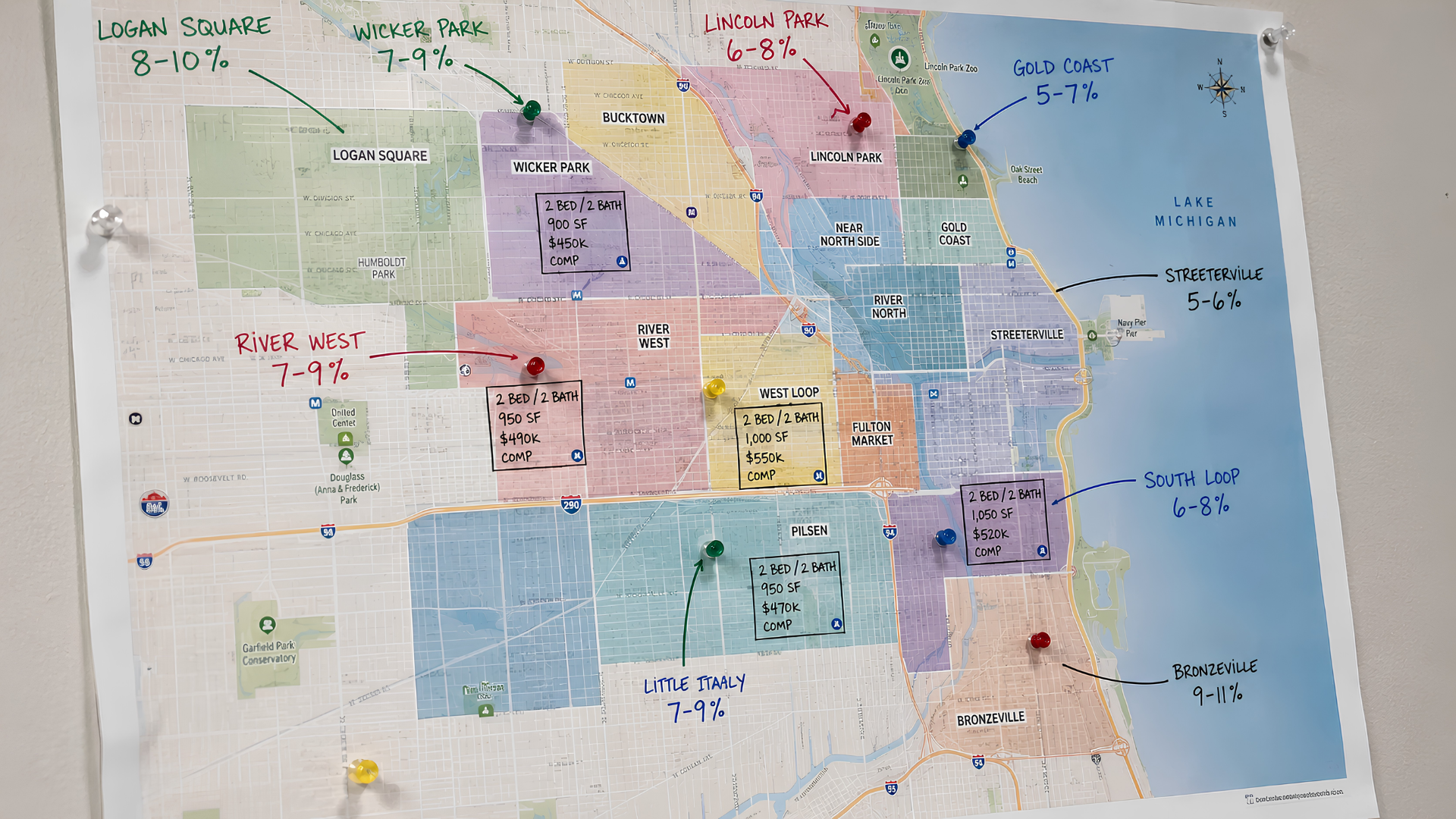
Cap rates in Chicago vary significantly depending on location, property type, and local rental demand. Understanding these ranges helps you spot undervalued deals and avoid overpaying in slower sub-markets.
| Neighborhood | Avg. Property Type | Estimated Cap Rate Range |
|---|---|---|
| Logan Square | 2-4 flat | 4.5% - 6.5% |
| Pilsen | 2-6 unit | 6.0% - 8.0% |
| Bronzeville | 2-6 unit | 6.5% - 9.0% |
| West Loop | Multi-unit condo | 4.0% - 5.5% |
| South Shore | 2-6 unit | 7.0% - 10.0% |
| Wicker Park | Mixed-use / 2-flat | 4.5% - 6.0% |
These estimates are directional and market conditions shift. For investors looking specifically at income-producing assets, our resource on the best neighborhoods for rental income chicago breaks down which areas are outperforming on a return basis right now.
What the Cap Rate Numbers Actually Mean
Knowing the formula is one thing. Knowing what to do with the result is another. Here is how to interpret common cap rate ranges:
Below 4%: Property is expensive relative to income. Common in prime Chicago neighborhoods like the Gold Coast or Lincoln Park. Lower risk, lower return.
4% to 6%: Typical for stable, in-demand urban neighborhoods. Acceptable for investors prioritizing appreciation over income.
6% to 8%: Solid income-generating range. Balance between risk and return. This is where most experienced Chicago investors like to operate.
8% to 10%+: Higher yield, but usually signals a transitioning neighborhood, deferred maintenance, or management-intensive property. Due diligence is critical.
According to research published by the Urban Land Institute, cap rate compression in major metro areas like Chicago has been a consistent trend over the past decade, meaning prices have risen faster than rents in many desirable sub-markets.
It is also worth understanding that how to calculate cap rate rental property math becomes less reliable if you use an inflated or deflated property value, and the denominator in that formula has to be accurate when you use a best chicago suburbs for buyers who want more space near the city comparison. That is why a current, professional valuation matters before you finalize any analysis.
Common Mistakes That Skew Your Cap Rate Calculation
Even experienced investors get tripped up on the inputs. These are the errors that most frequently produce misleading results:
Including mortgage payments in operating expenses. Debt service is not part of NOI. Cap rate is a pre-financing metric by design.
Using asking price instead of current market value. If a seller is overpriced by $75,000, your cap rate will look artificially low. Use actual market value.
Ignoring vacancy. Assuming 100% occupancy will give you an optimistic NOI that does not reflect real-world performance.
Underestimating maintenance. A rough rule of thumb: budget 1% of property value annually for repairs and capital expenditures.
Forgetting property management costs. Even self-managed properties have an implicit time cost that should be factored in.
For buyers weighing whether to rent or own in specific Chicago corridors, the analysis in is buying better than renting in chicago what south loop and west loop renters need to know puts these numbers into broader personal finance context.

Cap Rate vs. Other Key Metrics: Knowing When to Use What
Cap rate is powerful but not complete on its own. Here is how it stacks up against other common investment measures:
| Metric | What It Measures | Includes Financing? | Best Used For |
|---|---|---|---|
| Cap Rate | Property-level return | No | Comparing properties side by side |
| Cash-on-Cash Return | Return on actual cash invested | Yes | Evaluating leverage impact |
| GRM (Gross Rent Multiplier) | Price relative to gross rent | No | Quick initial screening |
| ROI | Total return including appreciation | Yes | Long-term investment analysis |
| IRR | Time-weighted return over hold period | Yes | Sophisticated portfolio analysis |
For most residential investors buying two-flats and multi-units in Chicago, cap rate and cash-on-cash return are the two metrics that matter most in the early stages of evaluation. The Federal Reserve Bank of Chicago periodically publishes research on Midwest real estate market conditions that can help you contextualize current cap rate trends within the broader economic environment.
Investors expanding their search beyond the city should also review our blogs for detailed market insights, since suburban multi-family cap rates can differ substantially from city rates.
Things to Know
Cap rate does not account for future appreciation, which can be a significant component of total return in high-demand Chicago neighborhoods.
Illinois property tax rates are among the highest in the nation, averaging about 2.07% of assessed value according to data from the Tax Foundation, which meaningfully compresses NOI for Chicago landlords.
A cap rate is only as reliable as the income and expense figures behind it. Always verify rent rolls and request 12-24 months of actual operating statements from the seller.
Market cap rates fluctuate with interest rates. When the 10-year Treasury yield rises, cap rates in most markets tend to follow over time.
For multi-family properties above four units in Illinois, different lending standards apply, which can affect how you structure your financing and ultimately your cash-on-cash return.
Using a tool like a professional home valuation before calculating cap rate ensures your denominator is grounded in real market data rather than a seller's wishful asking price.
Ready to Run the Numbers on a Chicago Investment Property?
Start with an accurate property value. Before anything else, use Option Premier's home valuation tool to get a current market estimate on any Chicago or suburban property you are evaluating. Once you have that number, the cap rate formula does the rest. If you want guidance on specific neighborhoods, income projections, or multi-unit deal analysis, reach out directly to the team at Option Premier LLC, located at 1021 W Adams St, Suite 200, Chicago, IL 60607. You can call (312) 500-5808 or email info@optionpremier.com to connect with a broker who understands Chicago investment real estate from the inside out.

Frequently Asked Questions
-
Divide the property's annual Net Operating Income by its current market value, then multiply by 100.
NOI is gross rental income minus all operating expenses, excluding debt service. For example, if a property has an NOI of $50,000 and a market value of $700,000, the cap rate is 7.14%. This number lets you compare the income efficiency of different properties regardless of how they are financed.
-
A 7.5% cap rate means the property generates a 7.5% annual return on its value before accounting for any mortgage payments.
This is generally considered a solid return in most U.S. markets, including many Chicago sub-markets. It suggests a reasonable balance between purchase price and income, though local context, property condition, and neighborhood trajectory all affect whether 7.5% represents a good deal in a specific situation.
-
The 2% rule states that a rental property's monthly rent should equal at least 2% of its purchase price.
For example, a $200,000 property would need to generate $4,000 per month in rent to meet the 2% rule. In most Chicago neighborhoods, achieving 2% is difficult due to high property values relative to rents. Investors in Chicago typically work within a 0.6% to 1.0% monthly rent-to-price ratio and rely on cap rate and cash-on-cash return for more realistic evaluation.
-
A cap rate between 5% and 10% is generally considered a good range for most U.S. rental properties.
The right target depends on your market, risk tolerance, and investment goals. In premium urban markets like Chicago's North Side, 4% to 6% may be acceptable if you expect strong appreciation. In transitional neighborhoods or Midwest markets with stable rents, 7% to 9% is a reasonable benchmark for an income-focused investor.
-
Beginners should generally target a cap rate of 6% to 8%, which offers enough income cushion to cover expenses and build experience without requiring perfect market timing.
Starting in that range means the property is generating meaningful income relative to its cost, reducing the pressure of an expensive hold if early management challenges arise. New investors should pair cap rate analysis with a professional property inspection, verified financials, and guidance from an experienced local broker before committing to any deal.
The Bottom Line on How to Calculate Cap Rate Rental Property
Understanding how to calculate cap rate rental property investments is the foundation of smart real estate investing in Chicago and anywhere else in the United States. The formula is simple, the math is accessible, and the insight it provides is immediate. What separates profitable investors from frustrated landlords is not just knowing the formula but knowing how to feed it accurate inputs, interpret the output in local context, and use it alongside other metrics to build a complete picture of any deal.
Whether you are analyzing a two-flat in Pilsen or a six-unit in Bronzeville, Option Premier's team has the neighborhood knowledge and investment experience to help you run the numbers correctly.
Reach out by submitting a form to connect with a local real estate agent and take the first step toward your next move!