Chicago Is No. 1 in Home Price Growth Again. What’s Keeping Prices Moving?
CHICAGO— At a time when home prices are barely moving in some parts of the country and actually falling in others, Chicago continues to stand out.
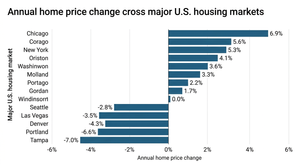
The Chicago-area Case-Shiller Home Price Index rose 6.86% year over year in July, the strongest increase among the major metropolitan markets tracked by the index. That was well ahead of the 1.93% national gain, with New York coming in second at 5.78% and Cleveland third at 4.22%. Seattle, by comparison, was down 1.57%. (S&P Dow Jones Indices)

Even more notable: Chicago has now led the major metros in annual price growth for five consecutive months.
So why is Chicago outperforming much of the country, even with mortgage rates back above 7%?
Chicago’s Biggest Advantage May Be Something Buyers Find Frustrating: Limited Supply
Price growth usually becomes much harder to sustain when borrowing gets expensive.
Chicago has been an exception in large part because the number of available homes has remained relatively constrained.
September data showed Chicago-area active listings down 5.3% from a year earlier, even as inventory nationally increased 5.4%. New listings in the Chicago market were also down 7.8% year over year. That creates a simple imbalance.

Higher mortgage rates may reduce how much some buyers can spend, but buyers still need somewhere to live. When fewer owners decide to sell, the homes that are priced well and located in desirable neighborhoods can continue attracting competition.
This helps explain why Chicago can simultaneously have affordability challenges and strong home-price appreciation.
It is not necessarily that demand is exploding.
There simply are not enough additional homes entering the market to meaningfully loosen conditions.
No. 1 Does Not Mean Every Chicago Home Rose 6.9%
This is an important distinction.
The Case-Shiller figure does not mean every Chicago homeowner gained 6.9% in value over the past year.
Case-Shiller tracks changes in prices for repeat sales of single-family homes across the Chicago metropolitan market. It is a price index, not the median sale price of Chicago homes, and it does not directly measure individual neighborhoods, condos or specific properties.
Your results can look very different depending on whether you own a loft in University Commons, a high-rise condo in South Loop, a single-family home in the Northwest Side or a house in one of the western suburbs.
More recent local data shows that variation clearly.
Across Chicago, September's median sold price was approximately $390,000, up 4% from a year earlier, while active inventory remained below 2025 levels. Individual neighborhoods and property types can move considerably faster or slower than that citywide figure.
That is why a national ranking is useful for understanding the broader direction of the market, but it should never replace a building-level, neighborhood-level or property-specific analysis.
What Does This Mean If You’re Buying?
The headline is not necessarily a reason to rush.
It is a reason to be realistic about waiting.
A buyer might reasonably hope that higher mortgage rates will push Chicago prices substantially lower. So far, the broader data has not supported that outcome. Prices have continued to appreciate while inventory remains tight.
That makes the decision less about predicting the perfect month and more about finding the right property at a payment you can comfortably afford.
Fall can still create opportunities.

Some homes accumulate market time. Others receive price reductions. Sellers who have already purchased another property or simply want to move before winter may become more flexible.
Buyers should watch listing history, days on market, previous price changes and competing inventory, not just whether the overall Chicago index is rising.
For condo buyers, there is another layer. A property that appears cheaper than nearby options may carry a higher HOA assessment, upcoming special assessment, weaker reserves or significant building work.
The best deal is not always the lowest asking price.
What Does This Mean If You’re Selling?
Chicago's strong appreciation gives sellers an encouraging backdrop, but it does not mean buyers will accept any asking price.
In fact, this may be where some sellers get the headline wrong.
If comparable homes have appreciated, your property may be worth more than it was last year. But buyers are also dealing with higher mortgage costs, which makes them particularly sensitive to value.

Pricing still needs to reflect the current competition.
Look not only at what sold three or six months ago, but also at the homes buyers can choose from right now.
If three similar condos are available in the same building, buyers will compare their condition, floor, view, parking, assessments and price almost side by side.
Chicago may be No. 1 nationally for appreciation, but buyers still decide one property at a time.
Chicago Is Moving in the Opposite Direction From Several Major Markets
Perhaps the most interesting part of the latest data is how geographically divided the housing market has become.
Chicago's 6.9% annual gain compares with declines in markets including Seattle, Las Vegas, Denver, Portland and Tampa. The gap between No. 1 Chicago and last-place Seattle was roughly 8.4 percentage points.

That is a reminder that there is no longer one simple “U.S. housing market.”
Some Sun Belt and western markets are working through larger increases in inventory and slower demand. Chicago entered this period with a different supply picture, helping support prices even as affordability became more challenging.
There is also an important caveat. National home prices rose 1.9% nominally in July while inflation was 3.4%, meaning U.S. home values were still declining when adjusted for inflation. Chicago's much stronger nominal appreciation places it in a very different position from the national average.
What Chicago’s No. 1 Ranking Really Tells Us
The biggest takeaway is not simply that Chicago homes became more expensive.
It is that Chicago continues to behave differently from much of the country.
Higher mortgage rates have not produced a major surge in listings. Buyers have not disappeared. And limited housing supply continues to put upward pressure on prices in many parts of the market.
For homeowners, that makes this an important time to understand how much appreciation has actually reached their neighborhood or building.
For buyers, it reinforces why waiting solely for a major Chicago price correction carries its own risk.
The national ranking gets the attention.
The local numbers are what determine your next move.
Wondering What Your Chicago Home Is Worth Now?
A 6.9% metro-wide increase does not automatically translate into a 6.9% increase for an individual home.
The Cory Tanzer Group at Option Premier helps homeowners and buyers look beyond broad market headlines by comparing recent sales, active competition, building-specific data and neighborhood trends to understand what is happening at the property level.
Stay Connected
Ranked among the top 1% of real estate teams in the Chicagoland market, The Cory Tanzer Group at Option Premier is recognized for proven sales performance, neighborhood expertise, and consistent results across Chicago and the surrounding suburbs.
In the 2026 RealTrends Verified rankings, based on 2025 sales data, the team completed 181 transaction sides representing $79.28 million in sales volume. The Cory Tanzer Group ranked No. 13 in Illinois by transaction sides, No. 20 in Illinois by sales volume, No. 270 nationally by transaction sides, and No. 439 nationally by sales volume.
The team also earned The CARLY, the highest honor for Platinum Sales Dollars and Platinum Units Sold, at the Chicago Association of REALTORS® Sales Awards.
Led by Cory Tanzer, the team helps buyers, sellers, investors, landlords, and renters navigate real estate across Downtown Chicago, the North Shore, and the Western Suburbs, with local expertise in University Village, University Commons, South Loop, West Loop, Little Italy, Pilsen, and surrounding Chicagoland communities.
Connect with The Cory Tanzer Group at Option Premier for trusted local market insight, personalized guidance, and a proven strategy for your next Chicago real estate move.