New Construction vs Existing Homes: Which Is the Better Deal in 2026?
For decades, buyers assumed new construction meant paying a premium over resale. In 2026, that assumption is no longer reliable in every market, and the gap between the two options is closer than most buyers realize.
Key Takeaways
New construction and existing home prices have converged nationally, with new homes sometimes pricing below resale comparables.
Builder incentives, including mortgage rate buydowns and closing-cost credits, can meaningfully reduce the total cost of a new home purchase.
Existing homes typically offer established neighborhoods, mature landscaping, and faster move-in timelines.
New construction comes with builder warranties that can offset early maintenance costs, but upgrade costs can climb quickly.
Chicago and its suburbs offer both new development and resale inventory, so local comparisons matter more than national averages.

The Price Gap Has Narrowed More Than You Think
The conventional wisdom used to be simple: new construction costs more, full stop. That thinking made sense when builders priced new homes at a significant premium to account for modern finishes, energy-efficient systems, and builder profit margins. But the market has shifted.
According to the National Association of Home Builders, the median price of a new single-family home in Q1 2026 was $403,200, compared to $404,600 for an existing home. That marked the fourth consecutive quarter in which the existing-home median exceeded the new-home median. For buyers who have been sitting out of new construction on price alone, that data is worth revisiting.
Part of this shift reflects the persistent shortage of resale inventory. Homeowners locked into low mortgage rates from prior years have been reluctant to list, which has kept existing-home supply tight and prices elevated. Builders, on the other hand, have responded to softer demand by offering incentives rather than letting unsold inventory pile up.
Our blogs cover local market dynamics in detail, including neighborhood-level data for buyers weighing specific submarkets.
What Builder Incentives Actually Look Like Right Now
Builder incentives are one of the most misunderstood parts of buying new construction. The advertised incentive is rarely the whole story, and buyers need to compare total cost rather than headline monthly payments.
Here is what builders are commonly offering in 2026:
Mortgage rate buydowns: Temporary or permanent buydowns that reduce your interest rate for a set number of years, often through the builder's preferred lender.
Closing-cost credits: Builders may cover some or all of your closing costs, which on a $400,000 purchase can represent thousands of dollars saved.
Free upgrades: Appliance packages, flooring upgrades, or finished basements added at no charge to move a specific unit.
Price reductions: Direct list-price cuts on spec homes that have been sitting on market longer than the builder expected.
The catch is that mortgage rate buydowns are often tied to using the builder's in-house lender. That lender may not offer the best overall terms, so you should always get an independent quote to compare. The Consumer Financial Protection Bureau has resources that explain how buydowns work and what questions to ask before committing to a specific lender.

New Construction vs Existing Homes: A Direct Comparison
| Factor | New Construction | Existing Home |
|---|---|---|
| Price trend (2026) | At or below resale median nationally | Slightly above new construction median |
| Move-in timeline | 6-18 months for to-be-built; immediate for spec | Typically 30-60 days after closing |
| Maintenance costs | Low in early years; warranty covers defects | Higher in years 1-5 depending on age |
| Builder warranty | Yes, typically 1-10 years depending on system | No warranty unless negotiated |
| Negotiability | Limited on base price; strong on incentives | More flexible on price and contingencies |
| Energy efficiency | Higher; built to current codes | Varies widely; older homes may need upgrades |
| Neighborhood feel | Developing; fewer mature trees and neighbors | Established; schools, amenities already known |
For Chicago buyers specifically, the comparison gets more nuanced. New construction condos in neighborhoods like the West Loop or Fulton Market command significant premiums because of location, while suburban new construction in areas like the western suburbs can be priced competitively against aging resale inventory. The Wheaton post breaks down one suburb where resale and new construction are both active and worth comparing.
When an Existing Home Is Still the Better Call
New construction does not win in every situation. Here are the scenarios where resale typically makes more sense:
Location is non-negotiable. If you need to be in a specific established neighborhood, school district, or walkable urban area, new construction may simply not be available where you want to live. Chicago's denser neighborhoods rarely have vacant lots for new single-family builds.
You need to move quickly. To-be-built homes in Illinois can take six months to over a year to complete. If you are relocating for work or have a lease ending in 60 days, a resale home fits your timeline.
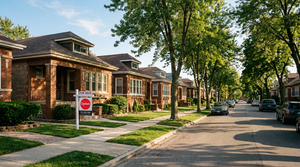
You want a mature yard and established character. New construction neighborhoods often feel sparse for the first few years. Buyers who value mature trees, character architecture, and a lived-in block often prefer resale.
The Illinois state fair 2026 coverage we published earlier this year is a good reminder that community feel matters, and established neighborhoods tend to have it in abundance.
Hidden Costs Worth Knowing Before You Decide
Both paths carry costs that are easy to underestimate. On the new construction side, watch for:
Lot premiums: Corner lots, cul-de-sac locations, or lots backing to open space can add $10,000 to $50,000 or more to your base price.
Upgrade creep: Model homes are staged with every upgrade checked off. The base price rarely includes what you see on display.
HOA fees in new developments: Many new construction communities come with homeowners associations that carry monthly fees and long-term obligations.
On the existing home side, budget for a thorough inspection. The American Society of Home Inspectors recommends that buyers factor in potential repair and deferred maintenance costs, particularly in homes more than 20 years old.
Our team at Option Premier works with buyers navigating both paths and can help you build out a realistic total-cost comparison before you commit.

Things to Know
Builder rate buydowns are sometimes only for a fixed term. After the buydown period ends, your payment can increase significantly.
New construction appreciation rates vary by submarket. In some Chicago suburbs, resale homes in desirable school districts have historically outperformed nearby new builds.
A home valuation tool can help you benchmark what resale homes in a target area are actually worth before you compare them to builder pricing.
Illinois requires builders to provide a one-year warranty on workmanship and a two-year warranty on mechanical systems under the Illinois New Home Warranty Act.
Neighborhood events and local community ties, like those you can read about in our Taylor Street Little Italy Festa 2026 coverage, are often stronger in established areas.
Take the Next Step With the Cory Tanzer Group
Whether you are leaning toward a new build or a resale home, working with an experienced local broker changes the quality of the decision you make. We help buyers compare real numbers, not marketing materials.
Reach out to the Cory Tanzer Group at Option Premier today. Call (312) 218-4483 or email cory@optionpremier.com to schedule a consultation. Tell us your timeline, your target area, and your budget, and we will map out both paths side by side so you can decide with confidence.
Frequently Asked Questions
-
Nationally in 2026, new construction median prices have dipped below existing home median prices for several consecutive quarters.
This is a notable shift from the traditional assumption that new homes cost more. However, upgrade costs, lot premiums, and HOA fees can push the total cost of a new home significantly above its base price, so compare all-in costs carefully.
-
It depends on your timeline, location needs, and how much flexibility you have in your budget.
New construction offers modern finishes and warranties, while existing homes offer established locations and faster closings. In Chicago specifically, location constraints often make resale the only practical option in many neighborhoods.
-
Yes, though builders tend to protect their base prices and prefer to negotiate through incentives instead.
Buyers often have more success negotiating closing-cost credits, rate buydowns, and free upgrades than a straight list-price reduction. Getting pre-approved independently before negotiating strengthens your position.
-
Builder-affiliated lenders sometimes offer below-market rates tied to specific incentive programs, but these rates may come with conditions.
You should always compare the builder's lender against at least two independent lenders. The Consumer Financial Protection Bureau mortgage resources can help you understand what to compare beyond the interest rate alone.
-
New construction appreciation varies by location, builder reputation, and how quickly the surrounding community matures.
In some Chicago suburbs, resale homes in premium school districts have appreciated at strong rates. New builds in less established areas may appreciate more slowly early on, then accelerate as the neighborhood fills in. Local market knowledge matters more than any general rule.
The Bottom Line on New Construction vs Existing Homes
The old assumption that new construction always costs more is no longer reliable in 2026. Prices have converged, builder incentives are real, and the right choice depends on your specific situation rather than a blanket rule.
If you are buying in Chicago or the surrounding suburbs, work with people who know both sides of this comparison at the ground level. Contact the Cory Tanzer Group at Option Premier at (312) 218-4483 or visit optionpremier.com to start the conversation.